
Are you planning a 2-week Europe trip? Discover the Europe Travel Cost for 2 Weeks breakdown for 2026, including flights, hotels, food, transport & daily budget tips to save money.
Introduction: Planning Your 2-Week Europe Adventure
Planning a two-week European vacation requires careful budgeting to ensure you experience the best of the continent without overspending. The total Europe travel budget for 2 weeks can vary significantly based on your travel style, chosen destinations, and seasonal timing.
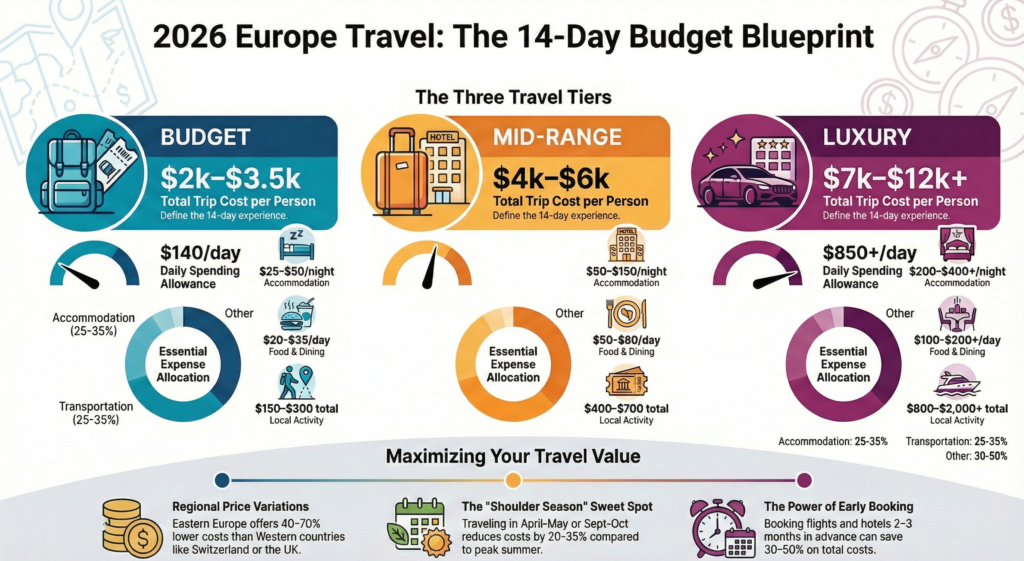
According to current tourism data and travel cost aggregators, travelers can expect to spend anywhere from $2,000 to $8,000+ per person for a 14-day European trip. This comprehensive guide breaks down all expenses to help you plan your ideal European adventure within your budget.
read: Cheapest Countries to Visit in Winter-You’ll Be Surprised to Know
Average Europe Travel Budget for 2 Weeks: Quick Overview
Here’s a snapshot of what travelers typically spend on a 14-day European journey:
| Budget Category | Budget Travel | Mid-Range Travel | Luxury Travel |
|---|---|---|---|
| Total Cost | $2,000-$3,500 | $4,000-$6,000 | $7,000-$12,000+ |
| Daily Budget | $140-$250 | $285-$430 | $500-$850+ |
| Accommodation | $25-$50/night | $80-$150/night | $200-$400+/night |
| Food | $20-$35/day | $50-$80/day | $100-$200+/day |
| Transport | $300-$600 total | $600-$1,000 total | $1,200-$2,500+ total |
These estimates are based on publicly available travel data and may vary depending on specific destinations, travel dates, and individual preferences.
read: Thailand vs Bali Cost: Which Is Cheaper? Complete Travel Cost Comparison 2026
Detailed Cost Breakdown: What to Expect

Accommodation Costs (14 Nights)
Accommodation represents one of the largest expenses for European travel. Costs vary significantly by city and country.
Read: Vietnam Travel Cost Per Day: Complete Budget Guide for 2026
Budget Options ($350-$700 total):
- Hostel dormitories: $25-$40 per night
- Budget hotels in Eastern Europe: $35-$50 per night
- Shared Airbnb rooms: $30-$45 per night
Mid-Range Options ($1,120-$2,100 total):
- Three-star hotels: $80-$120 per night
- Private Airbnb apartments: $90-$150 per night
- Boutique guesthouses: $100-$130 per night
Luxury Options ($2,800-$5,600+ total):
- Four and five-star hotels: $200-$350 per night
- Luxury boutique properties: $300-$400+ per night
- Premium Airbnb locations: $250-$350 per night
Western European cities like Paris, London, Amsterdam, and Zurich typically cost 40-60% more than Eastern European destinations like Prague, Budapest, or Krakow.
read: 10 Asian Cheap Islands Where You Can Travel for Under $50 a Day (2026 Update)
Food and Dining Expenses

Food costs depend heavily on your dining choices and destination cities.
Budget Dining ($280-$490 total):
- Supermarket meals and self-catering: $8-$12 per day
- Street food and casual eateries: $12-$23 per meal
- Total daily estimate: $20-$35
read: How Many Days Are Enough for Paris Trip?
Mid-Range Dining ($700-$1,120 total):
- Breakfast at cafés: $8-$15
- Lunch at local restaurants: $15-$25
- Dinner at mid-range restaurants: $25-$40
- Total daily estimate: $50-$80
Luxury Dining ($1,400-$2,800+ total):
- Fine dining experiences: $80-$150 per meal
- Michelin-starred restaurants: $150-$300+ per meal
- Premium cafés and wine bars: $30-$60
- Total daily estimate: $100-$200+
read: Netherlands Budget Shock: 10 Days Travel Cost Breakdown (2026)
According to tourism statistics, Western Europe generally costs 30-50% more for dining compared to Southern and Eastern European countries.
Transportation Costs

International Flights: Round-trip flights from North America to Europe typically range from $500-$1,500 depending on season, departure city, and booking timing. Flights from Asia or other continents vary significantly.
read: Japan vs Korea Travel Cost Comparison
Inter-European Transport Options:
| Transport Method | Cost Range (14 days) | Best For |
|---|---|---|
| Eurail Pass | $350-$650 | Multiple countries |
| Point-to-point trains | $200-$500 | Specific routes |
| Budget airlines | $150-$400 | Long distances |
| Buses (FlixBus, etc.) | $100-$250 | Budget travelers |
| Car rental | $400-$800+ (including fuel) | Rural areas, flexibility |
Local Transportation ($70-$200 total):
- Metro/bus daily passes: $5-$12 per day
- Individual tickets: $2-$4 per ride
- Taxis/ride-sharing: $10-$30 per trip
read: US Passport power: Visa-Free Countries Every US Passport Holder Should Know
Activities and Attractions

Budget Approach ($150-$300 total):
- Free walking tours (tips typically $5-$15)
- Free museums on designated days
- Self-guided exploration
- One or two paid attractions: $15-$25 each
Read: 5 Days in Bali Travel Budget: Daily Budget Breakdown You Must See Before Booking!
Mid-Range Approach ($400-$700 total):
- Major museum entries: $15-$30 each
- Guided tours: $40-$80 per tour
- City passes: $50-$100 per city
- Special experiences: $50-$100 each
Luxury Approach ($800-$2,000+ total):
- Private guided tours: $200-$500 per day
- Premium experiences: $150-$400 each
- VIP museum access: $80-$150
- Exclusive activities: $200-$600 each
read: Dubai Travel Cost from USA (Full Budget Guide 2026)
Miscellaneous Expenses
Additional costs typically include:
- Travel insurance: $50-$150 for 2 weeks
- SIM card/mobile data: $20-$50
- Souvenirs and shopping: $100-$500+
- Tips and gratuities: $50-$150
- Emergency fund: $200-$500 recommended
Read: Cheapest Cities in Europe 2026: Food, Hotel & Transport Breakdown Guide
Regional Cost Variations Across Europe

- Western Europe (Higher Cost): Countries: France, UK, Switzerland, Netherlands, Belgium, Germany (major cities). Daily Budget: $200-$400+ per person. Western European destinations typically represent the highest costs, with Switzerland and Scandinavia being particularly expensive. Accommodation and dining can cost 50-80% more than Eastern European alternatives.
- Southern Europe (Moderate Cost): Countries: Spain, Portugal, Italy, Greece. Daily Budget: $150-$300 per person. Southern European destinations offer better value while maintaining high-quality experiences. Spain and Portugal generally provide the best value in this region, while popular Italian cities like Venice and Rome can be more expensive.
- Eastern Europe (Budget-Friendly): Countries: Czech Republic, Poland, Hungary, Croatia, Romania. Daily Budget: $100-$200 per person. Eastern Europe offers exceptional value for budget-conscious travelers. High-quality accommodation, excellent food, and rich cultural experiences are available at significantly lower prices compared to Western Europe.
- Scandinavia (Premium Cost): Countries: Norway, Sweden, Denmark, Finland. Daily Budget: $250-$500+ per person. Scandinavian countries represent the most expensive European destinations, with costs often 100-150% higher than Western European averages.
read: Best Time to Visit Japan by Season Complete Month-Wise Travel Guide (2026)
Sample 2-Week Europe Itineraries with Costs
Budget Itinerary: Eastern Europe Focus
Route: Berlin → Prague → Vienna → Budapest → Krakow
Estimated Total Cost: $2,200-$3,200 per person
- Flights: $600-$900
- Accommodation (hostels/budget hotels): $420-$600
- Food (mix of self-catering and budget dining): $350-$490
- Transport (buses/budget trains): $200-$350
- Activities and attractions: $200-$350
- Miscellaneous: $230-$510
Read: 3 Days Netherlands trip for First-Time Travelers
Mid-Range Itinerary: Classic Western Europe
Route: London → Paris → Amsterdam → Brussels → Munich
Estimated Total Cost: $4,500-$6,200 per person
- Flights: $700-$1,200
- Accommodation (3-star hotels): $1,400-$1,960
- Food (local restaurants): $700-$1,120
- Transport (trains/flights): $500-$800
- Activities and attractions: $500-$700
- Miscellaneous: $400-$620
read: Thailand Travel Cost Breakdown for 7 Days (2026 Guide)
Luxury Itinerary: Premium European Experience
Route: Rome → Florence → Venice → Monaco → Paris
Estimated Total Cost: $8,500-$12,500+ per person
- Flights (business/premium economy): $1,500-$2,500
- Accommodation (4-5 star hotels): $3,500-$5,600
- Food (fine dining): $1,400-$2,800
- Transport (first-class trains/private): $1,000-$1,800
- Activities (private tours, VIP experiences): $1,000-$2,000
- Miscellaneous: $800-$1,200
read: Singapore Travel Budget for Couples (Daily Cost Explained)
Money-Saving Tips for European Travel
Before You Go
- Book in Advance: Flights and accommodation are typically 30-50% cheaper when booked 2-3 months ahead. Rail passes also offer better value when purchased early.
- Travel Off-Season: Visiting during shoulder seasons (April-May, September-October) can reduce costs by 25-40% while avoiding peak summer crowds.
- Choose Budget-Friendly Destinations: Mix expensive Western European cities with affordable Eastern European destinations to balance your budget.
During Your Trip
- Use Public Transportation: City metro systems and buses cost a fraction of taxis. Multi-day transit passes typically offer 20-30% savings over individual tickets.
- Eat Like Locals: Avoid tourist-area restaurants. Seek out local markets, lunch menus, and neighborhood eateries where prices can be 40-60% lower.
- Free Walking Tours: Most major European cities offer free walking tours (tip-based) that provide excellent introductions to destinations.
- City Tourist Cards: Many cities offer tourist cards providing free public transport and museum entries. These can save $30-$80 per day, depending on the city.
- Picnic Lunches: Purchasing food from supermarkets for one meal per day can save $15-$30 daily.
- Book Accommodation with Kitchens: Self-catering for some meals can reduce food costs by 30-50%.
read: Why the Cayman Islands Are Most Beautiful Escapes One of the Caribbean’s
When to Visit: Seasonal Cost Considerations

Peak Season (June-August)
- Pros: Best weather, longest daylight hours, all attractions open
- Cons: Highest prices (30-50% more), largest crowds
- Best For: Those with inflexible summer schedules
Read: Best Places in China to Visit That Will Completely Surprise You
Shoulder Season (April-May, September-October)
- Pros: 20-35% lower costs, smaller crowds, pleasant weather
- Cons: Slightly less predictable weather
- Best For: Budget-conscious travelers seeking value
Low Season (November-March, excluding holidays)
- Pros: Lowest prices (40-60% off peak), minimal crowds
- Cons: Shorter days, colder weather, some attractions closed
- Best For: Extreme budget travelers, winter sports enthusiasts
Holiday periods (Christmas, Easter, New Year’s) see price increases of 30-70% even during otherwise low season.
read: 10 Best Places in the Dominican Republic You Have to Experience Yourself
Visa and Entry Requirements
Schengen Area
Most European countries belong to the Schengen Area, which allows free movement between member states. Visitors from many countries can stay up to 90 days within a 180-day period without a visa.
read: Top 10 Destinations in Israel You Must Visit at Least Once
Countries typically not requiring visas for short stays (check current rules):
- United States, Canada, Australia, New Zealand
- United Kingdom, Japan, South Korea
- Many others (verify based on your nationality)
Always verify current visa requirements, as rules may change.
ETIAS Authorization (Implementation Expected)

The European Travel Information and Authorization System (ETIAS) is expected to be required for visa-exempt travelers. The cost is anticipated to be approximately €7 ($7-8) and valid for three years.
Note: Implementation dates and requirements may vary. Check official government sources before travel.
read: Top Attractions in Kuwait You Can’t Miss in 2026
Travel Insurance Considerations
Travel insurance for a 2-week European trip typically costs $50-$150, depending on coverage level and traveler age.
Recommended Coverage:
- Medical emergencies: $50,000-$100,000+
- Trip cancellation/interruption
- Lost or delayed baggage
- Emergency evacuation
According to insurance industry data, approximately 1 in 6 travelers file insurance claims, making coverage a prudent investment.
Frequently Asked Questions
How much money do I need for 2 weeks in Europe?
The total cost for 2 weeks in Europe typically ranges from $2,000-$12,000+ per person, depending on travel style. Budget travelers can manage with $2,000-$3,500, mid-range travelers should budget $4,000-$6,000, while luxury travelers may spend $7,000-$12,000 or more.
Read: Top Places Visit in Malaysia Before It Becomes Overcrowded
Is $5,000 enough for 2 weeks in Europe?
Yes, $5,000 is generally sufficient for a comfortable mid-range European vacation for 2 weeks. This budget allows for decent accommodation, regular dining at local restaurants, inter-city train travel, and popular tourist activities across most European destinations.
What is the cheapest way to travel around Europe for 2 weeks?
The most budget-friendly approach combines budget airlines for longer distances, buses (FlixBus, Eurolines) for medium routes, and public transportation within cities. Accommodation in hostels or budget hotels in Eastern European countries can further reduce costs by 40-60% compared to Western Europe.
Read: Top Must-Visit Places in Nigeria for First-Time Visitors
How much cash should I bring to Europe for 2 weeks?
Most travelers carry $200-$500 in cash (converted to euros or local currency) for emergencies and small purchases. Credit and debit cards are widely accepted across Europe. Notify your bank before travel to avoid card blocks, and consider cards with no foreign transaction fees.
Read: Top Amazing Places to Visit in Oman in 2026
Which European countries are the cheapest to visit?
Based on tourism cost data, the most affordable European countries include Poland, Hungary, Czech Republic, Romania, Bulgaria, and Portugal. These destinations offer high-quality experiences at 40-70% lower costs than Western European countries like Switzerland, Norway, or the United Kingdom.
What’s included in a typical Europe travel budget for 2 weeks?
A comprehensive 2-week Europe budget should include international flights, inter-city transportation, accommodation for 14 nights, meals, attraction entries, local transportation, travel insurance, and miscellaneous expenses like souvenirs, tips, and emergency funds.
Can I visit multiple countries in 2 weeks in Europe?
Yes, visiting 3-5 countries is realistic for a 2-week European trip. The Schengen Area allows free movement between 27 countries. However, limiting yourself to 3-4 destinations allows for deeper exploration and reduces transportation costs and time spent traveling.
Read: Top Stunning Places to Visit in Panama for Nature & Beach Lovers
When is the best time to visit Europe on a budget?
The shoulder seasons (April-May and September-October) offer the best value, with costs approximately 20-35% lower than peak summer months. Weather remains generally pleasant, crowds are smaller, and most attractions remain open. November through March offers even lower prices but with trade-offs in weather and daylight hours.
Summary: Planning Your Europe Travel Budget: Creating a realistic Europe travel budget for 2 weeks requires careful consideration of destination choices, travel style preferences, and seasonal timing. Budget-conscious travelers can experience Europe meaningfully for $2,000-$3,500, while those seeking more comfort should plan for $4,000-$6,000. Luxury travelers can expect to invest $7,000-$12,000 or more for premium experiences.
Key Budget Factors:
- Accommodation represents 25-35% of total costs
- Food and dining account for 20-30% of expenses
- Transportation (including flights) comprises 25-35% of budgets
- Activities and attractions typically represent 10-15% of costs
Cost Optimization Strategies:
- Mix expensive and affordable destinations
- Travel during shoulder seasons for 20-35% savings
- Use public transportation and city tourist cards
- Balance restaurant dining with self-catered meals
- Book flights and accommodation well in advance
By carefully planning your itinerary, choosing appropriate accommodation, and implementing money-saving strategies, you can create a memorable 2-week European adventure within virtually any budget range.
Important Disclaimer: This guide is based on publicly available tourism data, official travel resources, and general cost estimates collected from travel industry sources. Actual costs may vary significantly depending on:
- Specific travel dates and booking timing
- Individual travel preferences and choices
- Currency exchange rate fluctuations
- Seasonal demand variations
- Specific cities and neighborhoods chosen
- Current economic conditions
Prices and visa requirements are subject to change. Always verify current costs, entry requirements, and travel advisories through official government sources and reputable travel providers before finalizing your travel plans. Cost estimates provided represent typical ranges but should not be considered guaranteed pricing.
For the most current and accurate information, consult official tourism boards, embassy websites, and established travel booking platforms before making financial commitments.
We’d appreciate hearing about your experience reading our article.
Read: Cheap Weekend Getaways in the U.S.
Why Trust TourGid
Short breaks consistently prove more practical than week-long trips, not just because they squeeze into your schedule more easily, but because they do less damage to your bank account. TourGid contributors have hit the road to explore wallet-friendly spots across the country: forgotten state parks, coastal communities that fly under the tourism radar, you name it. Every time out, we’ve tracked what we actually spent and figured out where you can cut corners without sacrificing the parts of a trip that matter. The destinations you’ll find here aren’t algorithmic suggestions; they’re places we’ve visited ourselves, with help from readers who’ve nailed the art of the weekend getaway.
We’ve double-checked the numbers, confirmed current rates, and featured them because they deliver real experiences minus the usual sticker shock that comes with planning time away. However, if you want to read about
If you have any questions about this blog, its content, or any travel destination, please feel free to comment below. We are trying to discuss this place in our next content. If you want to read about the Best amazing places in New Zealand that you can visit, you can read this article