

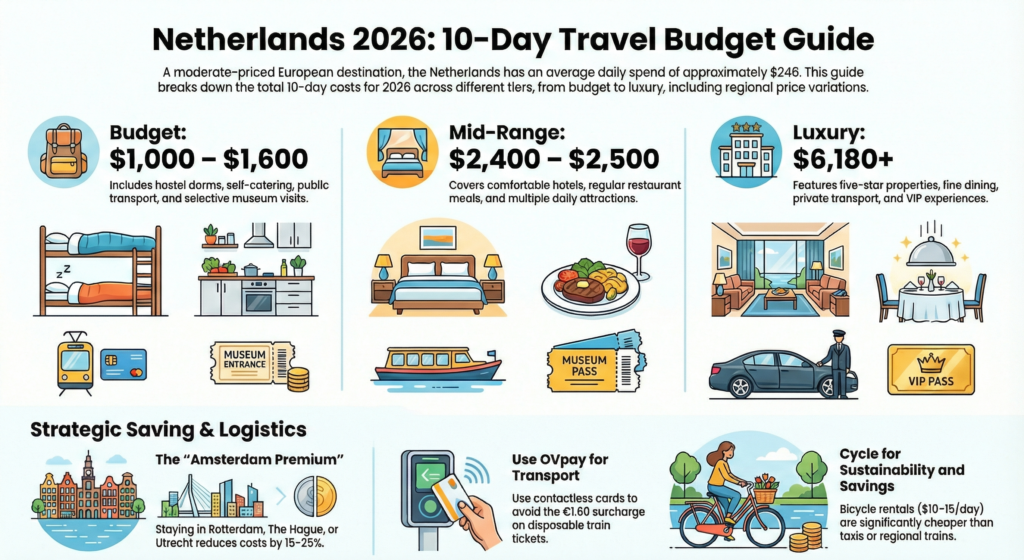
Planning a Netherlands Budget travel cost for a 10-day trip requires understanding the comprehensive expenses across accommodation, food, transportation, attractions, and miscellaneous spending in one of Europe’s most organized yet moderately priced destinations. According to recent tourism data from 2026, a 10-day Netherlands trip costs approximately $990-1,600 for budget travelers, $2,480-2,500 for mid-range visitors, and $6,180+ for luxury seekers, with significant variations based on travel style, seasonal timing, and city selections.
This comprehensive budget guide examines daily and total expenses for 10-day Netherlands vacations, providing verified cost breakdowns to help travelers plan realistic budgets while experiencing Dutch canals, world-class museums, tulip fields, historic windmills, and cycling culture. The Netherlands offers exceptional infrastructure and safety while maintaining costs generally lower than Scandinavia or the United Kingdom, but higher than Southern or Eastern Europe.
Understanding the Netherlands Budget Structure in 2026
The Netherlands operates as a moderately priced European destination according to comparative tourism data. Within Europe, Dutch travel costs align approximately with Denmark and Iceland while exceeding Germany, Belgium, and most Southern European nations. According to Statistics Netherlands, typical visitors spend approximately €212 ($246) per day, though this average varies substantially based on accommodation choices, dining preferences, and activity selections.
The Euro (EUR) serves as the Netherlands’ currency. As of early 2026, exchange rates average approximately €1 = $1.16 USD, creating favorable conditions for American travelers compared to historical rates. The Dutch economy maintains cashless payment dominance with many businesses operating “pin-only” policies refusing physical currency, making credit cards and OVpay contactless payments essential for travelers.
Regional Price Variations
Amsterdam commands premium pricing across all categories due to international tourist demand and limited historic center accommodation capacity. Rotterdam, The Hague, and Utrecht offer 15-25% lower costs than Amsterdam while maintaining excellent attractions and infrastructure. Smaller cities, including Leiden, Delft, Haarlem, and Maastricht, provide authentic Dutch experiences at reduced prices, while rural areas deliver the most affordable costs with fewer tourist-oriented services.
Read: Japan vs Korea Travel Cost Comparison
Daily Budget Breakdown by Travel Style
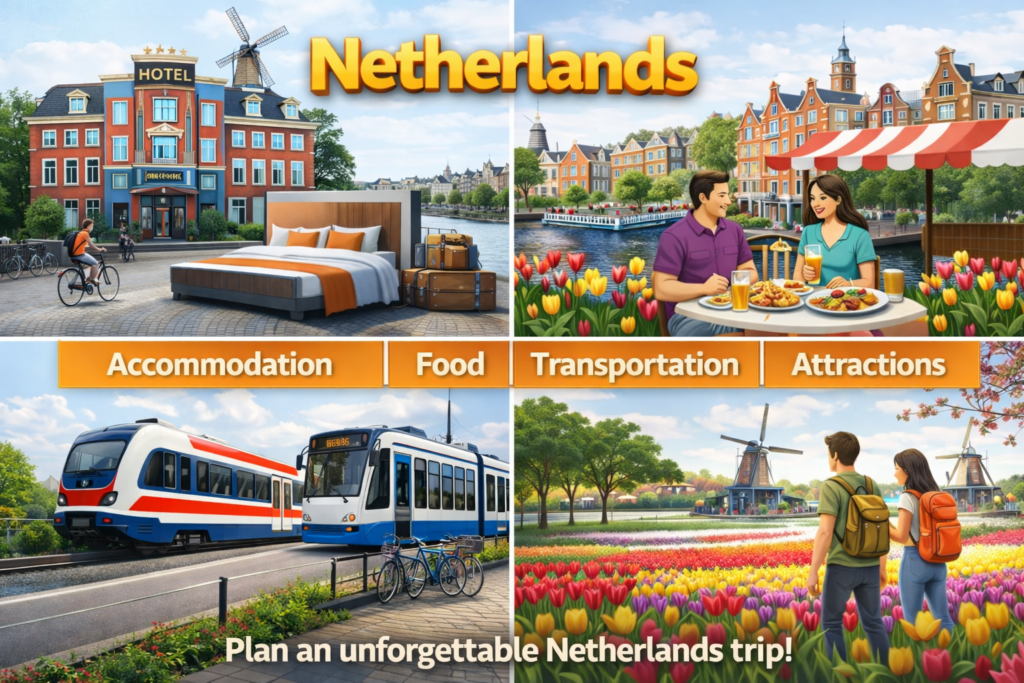
According to a comprehensive tourism cost analysis from multiple sources, including BudgetYourTrip and traveler expense data, daily Netherlands costs break down as follows:
Budget Travel: $100-160 per day
- Accommodation: $30-80 (hostel dormitories or budget hotels)
- Food: $25-45 (self-catering, fast-casual dining)
- Transportation: $8-15 (OV-chipkaart public transit)
- Attractions: $10-25 (free sites plus selective paid museums)
- Miscellaneous: $10-20
Mid-Range Travel: $248-250 per day
- Accommodation: $100-150 (three-star hotels, comfortable guesthouses)
- Food: $40-70 (restaurant dining, cafes)
- Transportation: $15-30 (public transit with occasional taxis)
- Attractions: $25-40 (museums, attractions, activities)
- Miscellaneous: $20-35
Comfortable Travel: $370-460+ per day
- Accommodation: $200-300 (four-star hotels, boutique properties)
- Food: $80-120 (quality restaurants, hotel dining)
- Transportation: $30-50 (mix of public transit and taxis/private transport)
- Attractions: $40-70 (premium experiences, private tours)
- Miscellaneous: $40-60+
Luxury Travel: $618+ per day
- Accommodation: $300-600+ (five-star hotels, luxury canal houses)
- Food: $150-250+ (fine dining, Michelin restaurants)
- Transportation: $60-120+ (private drivers, first-class rail)
- Attractions: $80-150+ (exclusive experiences, VIP access)
- Miscellaneous: $100+
These estimates represent per-person daily costs. Couples sharing accommodations reduce per-person lodging expenses while other categories remain relatively stable.
Read: US Passport power: Visa-Free Countries Every US Passport Holder Should Know
Complete 10-Day Budget Estimates
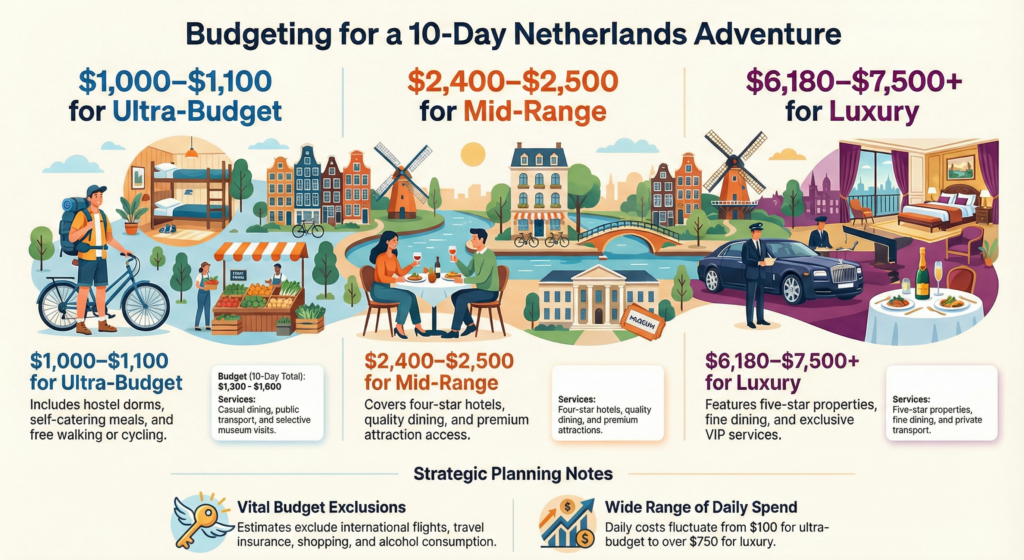
Based on verified tourism data and traveler expense reports, here are comprehensive 10-day Netherlands trip budgets:
| Budget Level | Daily Cost | 10-Day Total | What’s Included |
|---|---|---|---|
| Ultra-Budget | $100-110 | $1,000-1,100 | Hostel dorms, self-catering meals, cycling/walking, free attractions, minimal paid activities |
| Budget | $130-160 | $1,300-1,600 | Budget hotels/hostels, mix of cheap eats and casual dining, public transport, selective museum visits |
| Mid-Range | $240-250 | $2,400-2,500 | Four-star hotels, quality dining, convenient transport options, and premium attraction access |
| Comfortable | $370-460 | $3,700-4,600 | Four-star hotels, quality dining, convenient transport options, premium attraction access |
| Luxury | $618-750+ | $6,180-7,500+ | Five-star properties, fine dining, private transport, exclusive experiences, VIP services |
These totals exclude international flights, travel insurance, shopping, and extensive alcohol consumption, which vary dramatically by individual circumstances.
Read: 5 Days in Bali Travel Budget: Daily Budget Breakdown You Must See Before Booking!
Accommodation Costs for 10 Days
Lodging represents the largest variable expense component for Netherlands travelers, with Amsterdam commanding premium rates compared to other Dutch cities.
Budget Accommodation ($30-80 per night)
- Hostels: Dormitory beds in Amsterdam cost €25-50 ($29-58) per night according to current pricing data. Private hostel rooms range from €60 to €120 ($70-140) nightly. Rotterdam, The Hague, and Utrecht offer similar accommodations at 15-25% lower rates. Popular budget hostel chains include ClinkNOORD, Flying Pig, and Stayokay properties throughout major cities.
- Budget Hotels: Basic hotels and guesthouses near Amsterdam central cost €80-150 ($93-174) per night. Properties in outer neighborhoods or alternative cities range from €60-100 ($70-116) nightly. Business-oriented budget chains, including Ibis Budget and Meininger Hotels, provide reliable budget options.
10-Day Budget Accommodation Total: $300-800
Travelers can reduce costs by staying in cities outside Amsterdam for portions of their trip, booking well in advance (2-3 months), or visiting during off-peak seasons when rates drop 20-40%.
Read: Dubai Travel Cost from USA (Full Budget Guide 2026)
Mid-Range Accommodation ($100-150 per night)
Three-star hotels average approximately $100-150 per night according to booking platform data. Amsterdam properties typically charge €120-180 ($140-210) while Rotterdam and Utrecht average €90-140 ($105-163) nightly. Mid-range accommodations feature comfortable rooms, breakfast options, modern amenities, and central locations near public transport.
Neighborhoods offering good mid-range value include Amsterdam’s Jordaan, De Pijp, and Oud-West areas; Rotterdam’s Delfshaven; and historic Utrecht centers. Boutique guesthouses and converted canal houses provide characterful alternatives to chain hotels at comparable prices.
10-Day Mid-Range Accommodation Total: $1,000-1,500
read: Cheapest Cities in Europe 2026: Food, Hotel & Transport Breakdown Guide
Luxury Accommodation ($200-300+ per night)
Four-star properties average $160-250 per night, while five-star hotels average $200-400+ nightly. Amsterdam’s canal belt features iconic luxury hotels, including The Dylan, Waldorf Astoria, and InterContinental Amstel, commanding €300-600+ ($350-700+) per night. Rotterdam’s luxury options, including Mainport and The Slaak, maintain slightly lower pricing while delivering exceptional quality.
Luxury travelers often select converted historic mansions along Amsterdam canals, contemporary design hotels in Rotterdam, or countryside manor houses offering authentic Dutch experiences with premium service.
10-Day Luxury Accommodation Total: $2,000-6,000+
Seasonal Accommodation Pricing
Mid-January through early March represents the cheapest period, with accommodation rates dropping 20-40% compared to high-demand seasons. Mid-April through early May sees substantial price increases due to King’s Day (April 27) and tulip season at Keukenhof Gardens. Summer months (June-August) command premium rates during school holidays. Shoulder seasons (March, September-October) offer an optimal balance between reasonable weather and moderate pricing.
Booking platforms, including Booking.com, Hotels.com, and Airbnb, provide extensive Netherlands accommodation options. Direct booking occasionally yields better rates, particularly for smaller independent properties.
read: Best Time to Visit Japan by Season Complete Month-Wise Travel Guide (2026)
Food and Dining Costs
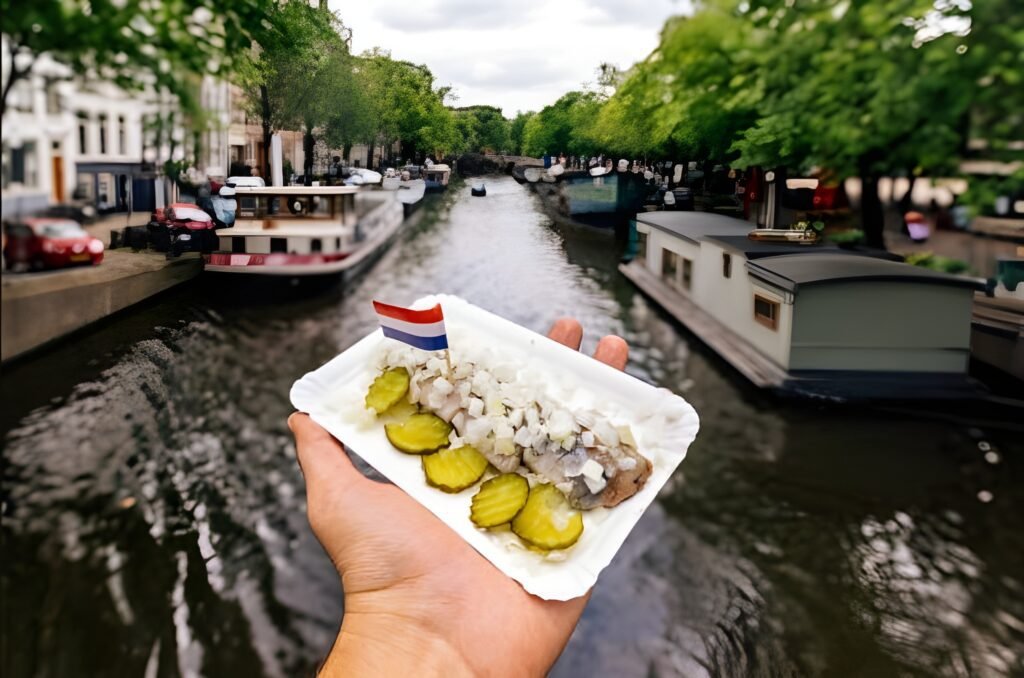
Dutch culinary costs vary dramatically based on dining choices, with budget travelers managing modest expenses while mid-range dining remains accessible compared to Scandinavian countries.
Budget Dining ($25-45 per day)
- Self-Catering: Supermarkets including Albert Heijn, Jumbo, Lidl, and Dirk offer groceries at moderate European prices. Basic breakfast items, bread, cheese, and lunch supplies cost €15-25 ($17-29) daily. Many hostels and budget hotels provide kitchen facilities enabling meal preparation.
- Fast-Casual Dining: Food courts and quick-service restaurants serve meals for €8-15 ($9-17) per person. Dutch fast-food chains FEBO (automated wall vending) offers kroket and frikandel for €2-4 ($2.30-4.65) each. International chains, including McDonald’s, serve combo meals for €8-12 ($9-14).
- Ethnic Restaurants: Indonesian, Surinamese, and Turkish restaurants provide exceptional value with complete meals costing €10-15 ($12-17) per person. Surinamese roti, considered Amsterdam’s best-value meal by budget travelers, costs approximately €10 ($12) for substantial portions.
- Bakeries and Markets: Dutch bakkerij (bakeries) sell inexpensive sandwiches and savory snacks for €3-6 ($3.50-7). Street markets offer affordable produce, cheese, and ready-to-eat options. Lunch specials (dagschotel) at cafes provide hot meals for €10-15 ($12-17).
Read: 3 Days Netherlands trip for First-Time Travelers
10-Day Budget Food Total: $250-450
Mid-Range Dining ($40-70 per day)
- Casual restaurant meals cost €15-30 ($17-35) per person for main courses according to menu pricing surveys. Complete dinners with appetizers and drinks average €25-40 ($29-46) per person at mid-level establishments. Popular Dutch dishes, including stamppot, bitterballen, and poffertjes, appear at accessible price points.
- Coffee at trendy Amsterdam cafes costs €3-5 ($3.50-5.80), while specialty coffee shops in other cities charge €2.50-4 ($2.90-4.65). Fresh juices and smoothies range €4-7 ($4.65-8.15). Beer costs €5-7 ($5.80-8.15) at casual bars and restaurants.
- Restaurant location significantly impacts pricing. Tourist-heavy areas near Dam Square, Rijksmuseum, and Anne Frank House charge 25-50% premiums compared to residential neighborhoods. Exploring De Pijp, Jordaan, or outer districts yields better dining value.
10-Day Mid-Range Food Total: $400-700
Fine Dining ($80-120+ per day)
- High-end restaurants charge €40-80+ ($46-93+) per person for main courses. Multi-course tasting menus at quality establishments range €60-120 ($70-140) per person before beverages. Michelin-starred restaurants, including De Kas, Rijks, and Restaurant C, command premium pricing with complete dining experiences exceeding €150-250 ($174-290) per person.
- Hotel restaurants and establishments near luxury accommodations typically charge 50-100% more than comparable independent venues. Fine dining in smaller cities like Maastricht or Utrecht delivers similar quality at 20-30% lower costs than Amsterdam’s premium restaurants.
Read: Thailand Travel Cost Breakdown for 7 Days (2026 Guide)
10-Day Fine Dining Total: $800-1,200+
Alcohol Costs
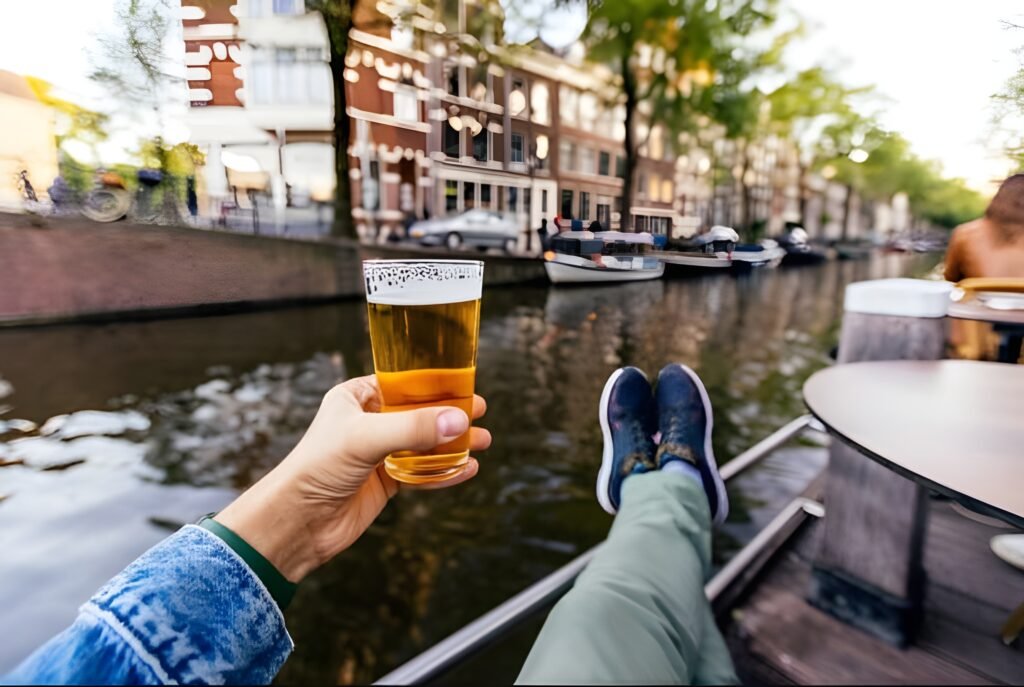
Beer at bars and restaurants costs €5-8 ($5.80-9.30), while supermarkets sell bottles for €1.50-3 ($1.75-3.50). Wine glasses average €5-9 ($5.80-10.45) at restaurants. Limiting alcohol consumption significantly reduces daily dining expenses, particularly as Dutch social drinking customs encourage multiple-round participation.
read: Singapore Travel Budget for Couples (Daily Cost Explained)
Transportation Costs
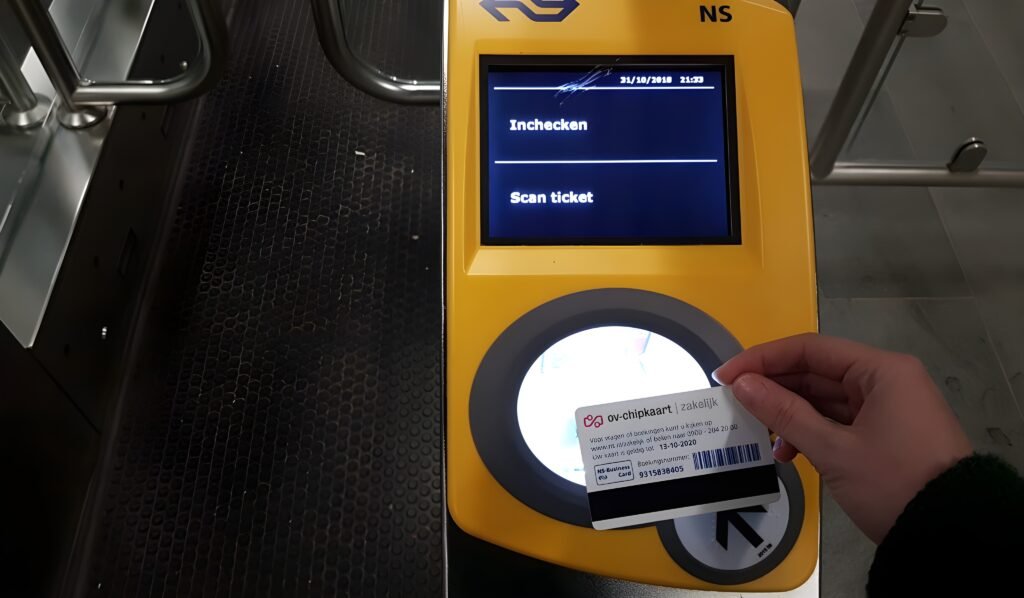
The Netherlands operates a world-class public transportation infrastructure with trains, trams, buses, and metros providing comprehensive connectivity at moderate costs compared to most Western European nations.
OV-Chipkaart and OVpay System
The OV-chipkaart serves as the Netherlands’ public transport smart card. Anonymous cards cost €7.50 (non-refundable) and remain valid for 4-5 years. Travelers load credit onto cards at ticket machines or service counters, with minimum balances of €4 for local transport and €20 for trains required at check-in.
Important 2026 Note: The OV-chipkaart will begin phasing out from 2026, with full discontinuation expected by the end of 2027. The replacement OV-pas utilizing newer OV-pay technology is now available for €6.
OVpay Contactless Payment: Introduced in 2023, OVpay allows travelers to check in and out using contactless debit/credit cards (Mastercard/Visa), Apple Pay, or Google Pay without purchasing an OV-chipkaart. Charges appear on statements the next day with “NLOV” reference. This system provides ideal convenience for tourists.
Read: Why the Cayman Islands Are Most Beautiful Escapes One of the Caribbean’s
Local Urban Transport Costs
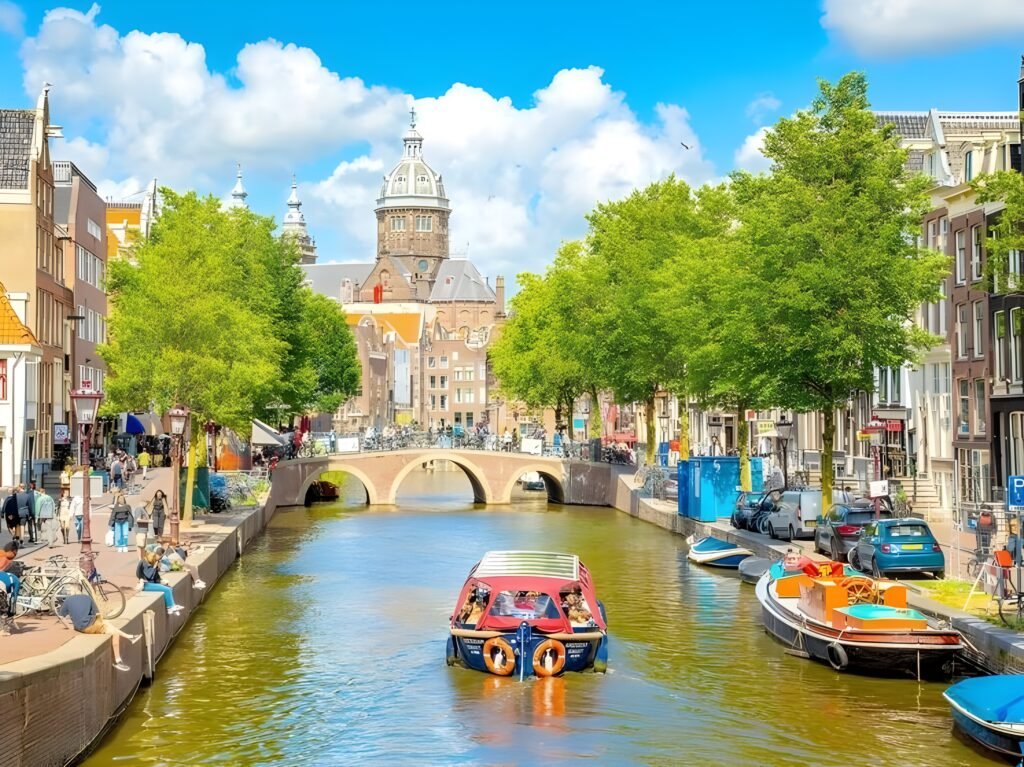
- Amsterdam: Metro and tram fares range from €3.50 for single tickets. Day passes cost approximately €8-9 for unlimited travel within city zones. Using OV-chipkaart or OVpay reduces per-journey costs compared to disposable tickets.
- Rotterdam, The Hague, Utrecht: Similar pricing structures with single journeys costing €2.50-3.50. Day passes range €6-8. Regional transport between nearby cities uses zone-based pricing increasing fares for longer distances.
10-Day Local Transport Estimate: $80-150 (assumes daily use of trams/metros/buses in cities)
read: Best Places in China to Visit That Will Completely Surprise You
Train Travel Costs
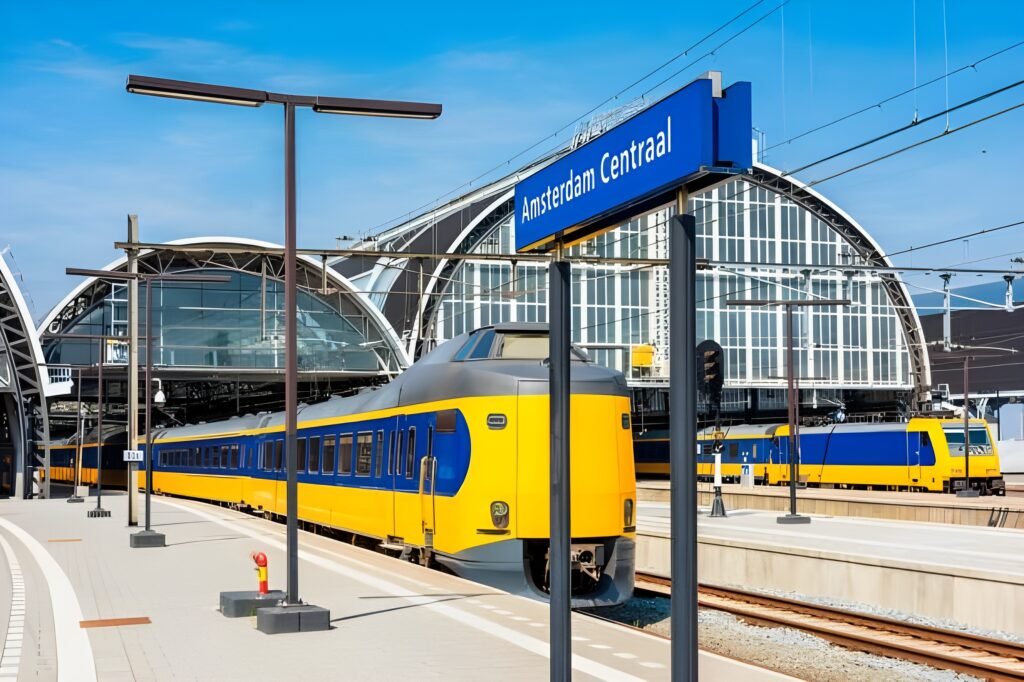
Dutch Railways (NS) operates efficient train services connecting all major cities. According to 2026 pricing:
- Amsterdam to Rotterdam: €15-20 one-way
- Amsterdam to Utrecht: €8-12 one-way
- Amsterdam to The Hague: €12-16 one-way
- Utrecht to Maastricht: €25-30 one-way
Disposable Train Tickets: Single-use tickets incur €1.60 surcharge above standard fares. Day return tickets (sum of two singles) also include a surcharge, totaling €3.20 if purchased as separate tickets.
Rail Pass Options: The Holland Travel Ticket provides unlimited second-class train travel plus buses, trams, and metros for €66.60 per day. The off-peak version offers better value for tourists. Multi-day visitors making 3+ train journeys daily benefit from this pass.
10-Day Train Travel Estimate: $200-350 (assumes 5-7 intercity trips, varies based on itinerary)
read: 10 Best Places in the Dominican Republic You Have to Experience Yourself
Bicycle Rental
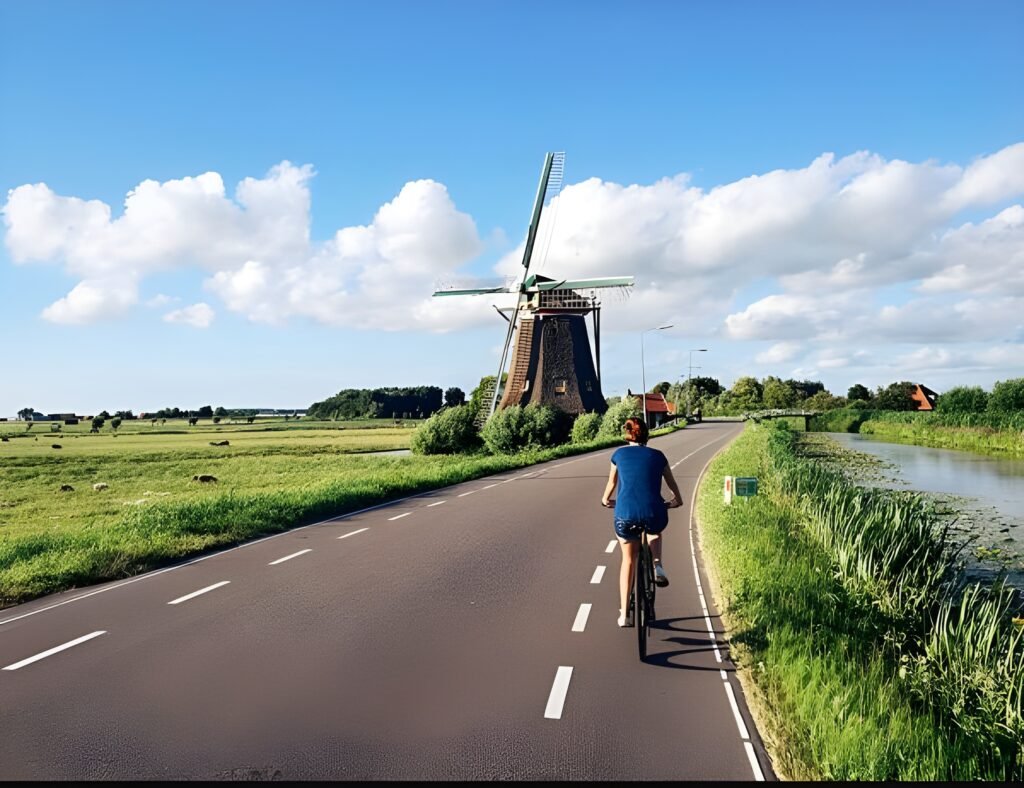
Cycling represents the most economical and authentic Dutch transportation. Bike rentals cost €10-15 per day at shops near train stations and city centers. Lower rates around €5-10 apply for longer-term rentals. The Netherlands ranks as the world’s most bicycle-friendly country with dedicated infrastructure throughout cities and the countryside.
10-Day Bicycle Rental: $50-150 (optional, replaces local transport costs)
read: Top 10 Destinations in Israel You Must Visit at Least Once
Taxi and Ride-Sharing
Taxis in Amsterdam cost significantly more than public transport, with typical rides within the city center running €15-30. Uber operates throughout major Dutch cities with pricing comparable to traditional taxis. Budget-conscious travelers avoid taxis except when absolutely necessary due to late-night schedules or heavy luggage situations.
Attraction and Entertainment Costs

The Netherlands offers diverse attractions from world-renowned museums to free cultural experiences, with strategic planning significantly impacting entertainment budgets.
Museum Entry Fees
Major Amsterdam museums charge the following approximate entrance fees:
- Rijksmuseum: €22.50
- Van Gogh Museum: €22
- Anne Frank House: €16 (advance booking required months ahead)
- Stedelijk Museum: €20
- Royal Palace Amsterdam: €12.50
Rotterdam museums, including Museum Boijmans Van Beuningen, cost approximately €15-20. Smaller city museums typically charge €8-15 entrance fees.
I Amsterdam City Card and Museumkaart
- I Amsterdam City Card: Provides unlimited public transport within Amsterdam plus free entry to numerous museums. Costs €70 for 24 hours, €85 for 48 hours, and €100 for 72 hours. Value depends on planned museum visits and transport usage – typically pays for itself with 3-4 major museums plus transport.
- Museumkaart: Annual pass providing access to 400+ museums throughout the Netherlands. Costs €75 for adults and remains valid for repeat visits throughout the year. Ideal for travelers planning extensive museum exploration across multiple cities or return visits. Compare the price to the planned museum entries to determine value.
read: Top Attractions in Kuwait You Can’t Miss in 2026
Paid Attractions

- Keukenhof Gardens (seasonal March-May): €25
- Kinderdijk Windmills: €10.50
- Canal boat tours Amsterdam: €18-25
- Heineken Experience: €21
- A’DAM Lookout observation deck: €16.50
Free Attractions
Numerous excellent free experiences include:
- Vondelpark Amsterdam
- Bloemenmarkt (flower market)
- Red Light District (observation only)
- Jordaan and De Pijp neighborhoods
- Rotterdam’s architectural landmarks
- Utrecht’s Dom Tower exterior and canals
- Delft and Haarlem historic centers
- Beach towns, including Zandvoort and Scheveningen
- Cycling through the countryside
- Weekly markets throughout cities
10-Day Attraction Budget Estimates:
- Budget (mostly free, 2-3 paid museums): $100-250
- Mid-range (balanced free/paid attractions): $250-400
- Comfortable (comprehensive museum access, tours): $400-700
- Luxury (VIP experiences, private guides): $800+
Additional Costs and Considerations
- Travel Insurance: Comprehensive travel insurance typically costs $50-100 for 10-day European trips, depending on coverage level, traveler age, and optional upgrades. Insurance covering medical emergencies, trip cancellation, and lost luggage provides essential protection. Many credit cards include basic travel insurance, though coverage often proves limited.
- SIM Cards and Connectivity: Tourist SIM cards from providers including Vodafone and KPN cost €15-30 for multi-day data packages. Many accommodations and public spaces offer free WiFi, though mobile connectivity provides convenience for navigation apps, OVpay payment, and communication.
- Tipping Practices: Tipping remains optional in the Netherlands as restaurant bills typically include service charges. Rounding up bills or leaving 5-10% for exceptional service is appreciated but not expected. Taxi drivers, hotel porters, and tour guides appreciate small gratuities, though tipping culture differs substantially from American practices.
- Shopping Budget: Shopping expenses vary wildly from zero to thousands, depending on personal interests. Amsterdam offers everything from cheese shops to designer boutiques. Traditional souvenirs, including Delftware pottery, wooden clogs, tulip bulbs, and Dutch chocolates, range from €10-100+. Serious shoppers should budget an additional €200-500+ beyond basic trip costs.
Read: Top Places Visit in Malaysia Before It Becomes Overcrowded
Money-Saving Strategies
- Travel During Off-Peak Season: January through March (except Christmas/New Year) offers 20-40% lower accommodation rates, smaller crowds, and generally better value across most categories.
- Stay Outside Amsterdam: Basing in Utrecht, Rotterdam, or Haarlem reduces accommodation costs 25-35% while maintaining easy day-trip access to Amsterdam via efficient trains.
- Shop at Budget Supermarkets: Lidl and Dirk offer significantly lower grocery prices than Albert Heijn, creating substantial savings for self-catering travelers.
- Cycle Everywhere: Bicycle rental costs a fraction of daily public transport expenses while providing an authentic Dutch experience and unlimited flexibility.
- Use OVpay Contactless: Avoid €1.60 surcharge on disposable train tickets by using OVpay contactless payment, saving €3.20+ per day return journey.
- Visit Free Attractions: Balance expensive museum visits with plentiful free experiences, including parks, neighborhoods, markets, and architectural exploration.
- Eat Lunch Specials: Many restaurants offer dagschotel lunch specials, providing hot meals for €10-15 compared to €20-30 dinner pricing.
- Purchase Museumkaart: If planning to visit 4+ museums, the €75 annual pass typically provides better value than individual tickets while enabling unlimited repeat visits.
- Book Advance Accommodations: Secure bookings 2-3 months ahead for 15-30% better rates than last-minute reservations, particularly during high-demand periods.
Sample 10-Day Budget Itinerary
Days 1-3: Amsterdam
- Budget accommodation Amsterdam: $240 (3 nights × $80)
- Food (mix self-catering/cheap eats): $105 (3 days × $35)
- Local transport (OVpay): $24 (3 days × $8)
- Attractions (1 free day, 2 museums): $45
- Subtotal: $414
Days 4-5: Haarlem and Keukenhof
- Budget accommodation Haarlem: $140 (2 nights × $70)
- Food: $70 (2 days × $35)
- Train Amsterdam-Haarlem: $15
- Bicycle rental: $20 (2 days)
- Keukenhof entry: $25
- Subtotal: $270
Days 6-7: Rotterdam
- Budget accommodation Rotterdam: $140 (2 nights × $70)
- Food: $70 (2 days × $35)
- Train Haarlem-Rotterdam: $20
- Local transport: $16 (2 days × $8)
- Attractions (mix free/paid): $30
- Subtotal: $276
Days 8-10: Utrecht and Return
- Budget accommodation Utrecht: $210 (3 nights × $70)
- Food: $105 (3 days × $35)
- Train Rotterdam-Utrecht: $15
- Train Utrecht-Amsterdam (day trip): $24
- Local transport: $24 (3 days × $8)
- Attractions: $40
- Subtotal: $418
10-Day Budget Trip Total: $1,378
This realistic budget itinerary demonstrates how travelers can experience multiple Dutch cities, major attractions, and authentic experiences within modest budgets through strategic planning and smart choices.
Frequently Asked Questions
- How much money do I need for 10 days in the Netherlands?
Budget travelers need approximately $1,000-1,600 for 10 days in the Netherlands including accommodation, food, transportation, and attractions. Mid-range travelers should budget $2,400-2,500, while comfortable travel requires $3,700-4,600. These estimates exclude international flights and assume strategic choices including staying in hostels or budget hotels, self-catering some meals, using public transportation extensively, and balancing free attractions with selective museum visits.
- Is the Netherlands expensive to visit?
The Netherlands ranks as moderately priced within Europe – generally more expensive than Southern or Eastern Europe but cheaper than Scandinavia, Switzerland, and the United Kingdom. Daily costs average €212 ($246) for typical travelers according to Statistics Netherlands. Amsterdam commands premium pricing while other cities offer 15-25% savings. Strategic planning including off-peak travel, budget accommodations outside city centers, self-catering, and public transportation keeps costs manageable compared to other Western European destinations.
- How much does food cost per day in the Netherlands?
Daily food costs range from $25-45 for budget travelers eating primarily at supermarkets, ethnic restaurants, and fast-casual venues to $40-70 for mid-range restaurant dining. Typical travelers spend approximately €46 ($53) daily on meals. Self-catering at budget supermarkets like Lidl dramatically reduces costs. Ethnic restaurants including Surinamese, Indonesian, and Turkish options provide exceptional value at €10-15 per meal. Fine dining easily exceeds $80-120+ daily.
- What is the cheapest time to visit the Netherlands?
Mid-January through early March represents the cheapest period for Netherlands travel with accommodation rates dropping 20-40% compared to peak seasons. However, this period brings cold, damp weather with short daylight hours. Shoulder seasons (March, September-October) balance moderate pricing with pleasant weather. Avoid mid-April through early May (King’s Day, tulip season), July-August (summer holidays), and December holidays when prices peak dramatically and advance booking becomes essential.
- How much do trains cost in the Netherlands?
Train fares depend on distance traveled with minimum €3 one-way fares and maximum €33.30 caps in 2026. Common routes include Amsterdam-Rotterdam (€15-20), Amsterdam-Utrecht (€8-12), and Amsterdam-The Hague (€12-16). Disposable tickets include €1.60 surcharge above standard fares – using OV-chipkaart or OVpay contactless payment avoids this charge. The Holland Travel Ticket provides unlimited travel for €66.60 daily, offering value for tourists making 3+ journeys.
- Is the I Amsterdam City Card worth buying?
The I Amsterdam City Card provides value if planning to visit 3-4 major museums plus extensive public transport use within Amsterdam. The 72-hour card costs €100 and includes free entry to Rijksmuseum (€22.50), Van Gogh Museum (€22), plus 40+ additional museums and unlimited trams/metros. Compare the card cost to planned museum entries and estimated transport expenses – it typically pays for itself with intensive sightseeing schedules but offers poor value for leisurely travelers visiting 1-2 museums.
- Can I use credit cards everywhere in the Netherlands?
Yes, credit cards and contactless payments enjoy near-universal acceptance throughout the Netherlands, with many businesses operating “pin-only” policies refusing cash. However, smaller vendors, street markets, and some traditional establishments still require cash. The Netherlands leads Europe in cashless transactions. Travelers should carry €50-100 cash for emergencies, markets, and occasional cash-only venues while relying primarily on cards for most purchases.
- How much should I budget for attractions in Amsterdam?
Major Amsterdam museums charge €16-22.50 entrance fees, with Rijksmuseum and Van Gogh Museum costing €22-22.50 each. Budget travelers visiting 2-3 museums over several days should budget $60-90 for attractions. Mid-range travelers planning comprehensive museum exploration plus canal tours and experiences should budget $150-250. Purchasing the Museumkaart (€75 annual pass) or I Amsterdam City Card (€100 for 72 hours) provides better value than individual tickets when visiting 4+ museums.
Summary: A 10-day Netherlands travel budget ranges from approximately $1,000-1,600 for budget-conscious travelers to $6,180+ for luxury experiences, with mid-range comfortable travel typically costing $2,400-2,500 per person. These estimates exclude international flights and assume strategic planning across accommodation, dining, transportation, and attraction selections.
Amsterdam commands premium pricing across all categories while Rotterdam, The Hague, Utrecht, and smaller cities offer 15-35% savings while delivering excellent Dutch experiences. Accommodation represents the largest variable expense, with budget travelers managing $30-80 nightly while luxury seekers spend $300-600+ in premium canal-side properties.
The Netherlands maintains world-class public transportation infrastructure with OV-chipkaart smart cards and new OVpay contactless payment providing convenient, moderately priced connectivity throughout the country. Budget travelers using public transit extensively spend approximately $80-150 for 10 days of comprehensive travel compared to $200-350+ for those making multiple intercity train journeys.
Food costs vary dramatically based on dining choices, from $25-45 daily for self-catering budget travelers to $80-120+ for restaurant-focused dining. The Netherlands provides exceptional ethnic restaurant value particularly at Indonesian, Surinamese, and Turkish establishments where complete meals cost €10-15.
Strategic money-saving approaches including off-peak travel (January-March, September-October), staying outside Amsterdam, cycling extensively, self-catering from budget supermarkets, using OVpay contactless payment, and balancing free attractions with selective museum visits dramatically impact overall trip costs while maintaining quality experiences.
The Netherlands delivers exceptional value through reliable infrastructure, comprehensive free attractions, efficient public services, and world-class museums justifying entry fees through unparalleled collections. Whether seeking budget adventure or luxury indulgence, the Netherlands accommodates diverse financial parameters while providing memorable cultural immersion, stunning architecture, and unique Dutch hospitality.
Disclaimer
This guide is based on publicly available tourism data, official travel resources, and general cost estimates current as of early 2026. Prices and rules may vary depending on season and traveler profile. Accommodation costs fluctuate dramatically between peak seasons (April-May tulip season, July-August summer, December holidays) and off-peak periods (January-March, September) with variations of 20-40% common. Food costs vary by establishment type, location (tourist areas versus residential neighborhoods), and dining style. Transportation prices subject to fuel cost fluctuations and seasonal demand. The OV-chipkaart system is transitioning to OV-pas with full phase-out expected by end of 2027.
Current information reflects 2026 status. Exchange rates between major currencies and the Euro fluctuate daily, impacting actual costs significantly. Museum entrance fees, attraction prices, and transport fares change periodically. Always verify current pricing through official sources, including NS.nl for train fares, museum websites for admission fees, booking platforms for accommodation rates, and the OV-chipkaart.nl website for public transport information before finalizing travel plans. This article provides informational guidance only and does not constitute official travel or financial advice.