
Planning your first Netherlands trip? A well-structured Netherlands itinerary 3 days allows first-time visitors to experience the country’s diverse attractions, from Amsterdam’s historic canals to Rotterdam’s modern architecture and charming Dutch countryside. This comprehensive Netherlands trip plan covers essential cities, transportation routes, and must-see attractions for an unforgettable experience.
The Netherlands offers exceptional connectivity, compact distances between major cities, and world-class attractions that make it ideal for short trips. According to tourism data, most destinations lie within two hours of Amsterdam, allowing travelers to maximize their time while experiencing Dutch culture, architecture, and natural beauty.
- Why the Netherlands is Perfect for a 3-Day Trip
- Best Time to Visit the Netherlands Trip
- Getting Around the Netherlands
- Day 1: Amsterdam Exploration
- Day 2: Rotterdam and The Hague
- Day 3: Utrecht and Day Trip Options
- Practical Travel Information
- Sample Budget Breakdown
- Essential Booking Tips
- Food and Dining Recommendations
- Netherlands Travel Etiquette
- Emergency Information
- Frequently Asked Questions
Why the Netherlands is Perfect for a 3-Day Trip
The Netherlands ranks among Europe’s most efficient countries for short visits. The extensive rail network connects major cities within 30-60 minutes, eliminating lengthy travel times. The country’s compact size means travelers can visit multiple destinations without feeling rushed. First-time visitors appreciate the Netherlands’ straightforward logistics. Train schedules run with precision, attractions cluster conveniently, and English proficiency throughout the country ensures smooth communication. These factors combine to create stress-free travel experiences even for those unfamiliar with European destinations.
Best Time to Visit the Netherlands Trip
The Netherlands experiences distinct seasonal variations that significantly impact travel experiences. Spring, particularly mid-April through early May, represents peak season when tulips bloom spectacularly across the countryside. Keukenhof Gardens operates only from March 20 to May 11 in 2025, displaying over 7 million flowering bulbs. Summer months from June through August bring warm weather, longer daylight hours, and peak tourist crowds. September offers pleasant temperatures with fewer visitors, making it an excellent alternative. Winter, while cold, showcases charming Christmas markets and lower accommodation prices, though some attractions operate on reduced schedules.
January through March typically sees better hotel rates and manageable crowds, though weather can be unpredictable with frequent rain. The country’s infrastructure ensures attractions remain accessible year-round despite weather variations.
Read: Thailand Travel Cost Breakdown for 7 Days (2026 Guide)
Getting Around the Netherlands
The Netherlands operates one of Europe’s most efficient public transportation systems. Nederlandse Spoorwegen (NS) trains connect all major cities with frequent service throughout the day.
- Train Travel Basics: Standard train fares depend on distance traveled, with prices increasing approximately 6.5 percent in 2026 and 2027. Example routes include Amsterdam to Rotterdam in approximately 40 minutes and Amsterdam to Utrecht in under 30 minutes. First-class tickets cost roughly 80 percent more than second-class fares. Travelers can purchase tickets through multiple methods, including the NS website, mobile app, station ticket machines, or service counters. E-tickets purchased online cost approximately €1 less than paper tickets. Disposable single-use tickets include a €1 surcharge for the ticket itself.
- OV-Chipkaart Option: The OV-Chipkaart smart card works across all Dutch public transport, including trains, buses, trams, and metros. The card costs €7.50 and remains valid for 4-5 years. Travelers must maintain a minimum credit of €20 for train travel. The card eliminates the €1 disposable ticket surcharge for frequent travelers.
- Day Travel Options: The Holland Travel Ticket provides unlimited second-class train travel plus buses, trams, and metros for €66.60 per day. The off-peak version offers better value for tourists visiting outside rush hours. Amsterdam & Region Travel Tickets cover specific zones at lower prices.
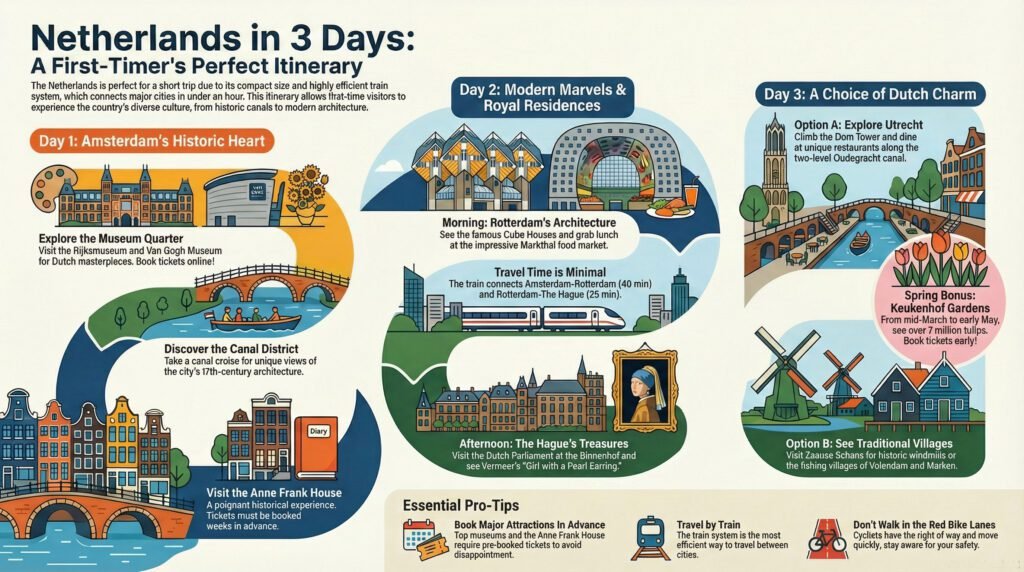
Day 1: Amsterdam Exploration

Amsterdam serves as the ideal starting point for first-time Netherlands visitors. The capital city combines historic architecture, world-class museums, and distinctive canal culture.
- Morning: Museum Quarter: Begin at Amsterdam’s Museum Quarter near the famous canals. The Rijksmuseum houses Dutch and Flemish masterpieces, including Rembrandt’s “The Night Watch” and Vermeer’s “The Milkmaid.” This national museum blends Gothic and Renaissance architecture and opened in 1885. The Van Gogh Museum sits nearby, showcasing 700 paintings and drawings from the legendary artist’s career. Notable pieces include “Sunflowers,” “Irises,” and works spanning his entire artistic journey. Both museums require advance ticket booking to avoid long queues.
- Midday: Vondelpark and Jordaan: Vondelpark, Amsterdam’s most famous green space, offers 105 hectares of gardens, bike paths, cafes, and open-air entertainment. The park provides a peaceful respite from urban exploration. The nearby Jordaan neighborhood features charming streets, independent boutiques, art galleries, and cozy cafes perfect for lunch.
- Afternoon: Anne Frank House and Canal District: The Anne Frank House represents one of Amsterdam’s most significant historical attractions. This museum preserves the hiding place where the Frank family concealed themselves during World War II. Tickets sell out weeks in advance and must be purchased online. Following the museum visit, explore Amsterdam’s UNESCO-listed canal district. The 17th-century canal ring with its narrow houses and tree-lined waterways creates Amsterdam’s distinctive character. Consider taking a canal cruise for unique perspectives on the city’s architecture and history.
- Evening: Red Light District or Cultural Exploration: Amsterdam’s Red Light District, located in the de Wallen neighborhood near Centraal Station, represents a unique aspect of Dutch liberal culture. Visitors should approach respectfully, noting that photography and public nudity are prohibited. The Museum of Prostitution offers an educational context. Alternative evening options include exploring the Nine Streets shopping district, visiting the vibrant Rembrandtplein square, or dining in Amsterdam’s diverse restaurant scene.
- Amsterdam Accommodation: The Jordaan neighborhood offers a central location with excellent canal access. Other recommended areas include De Pijp, Oud-West, and neighborhoods near Museumplein. Budget travelers find options in areas like Chinatown or slightly outside the canal ring with good tram connections.
Day 2: Rotterdam and The Hague
Day two ventures south to experience dramatically different Dutch cities. Rotterdam showcases cutting-edge modern architecture, while The Hague combines governmental significance with coastal charm.
- Morning Train to Rotterdam: Trains from Amsterdam Centraal to Rotterdam Centraal operate frequently throughout the day, covering the distance in approximately 40 minutes. The Intercity Direct service costs an additional €3 supplement but saves travel time.
- Rotterdam Architecture Tour: Rotterdam’s modern skyline contrasts sharply with Amsterdam’s historic character. The city, almost entirely rebuilt after World War II bombing, embraced innovative architecture and urban design. The Cube Houses (Kubuswoningen), designed by Piet Blom, rank among Rotterdam’s most photographed attractions. These tilted geometric houses sit above Blaak station. A show-house museum costs €3 entry and takes approximately 10 minutes to tour. Markthal, opened in 2014, combines residential apartments with an impressive indoor food market. The horseshoe-shaped structure features spectacular ceiling artwork titled “Horn of Plenty” depicting oversized fruits, vegetables, and flowers. The market offers global cuisine from dozens of food stalls.
- Rotterdam Additional Attractions: The Euromast tower provides 360-degree panoramic views from 112 meters above the city. The rotating Euroscoop elevator extends the viewing experience higher. The observation deck offers spectacular harbor and cityscape perspectives. Fenix Food Factory, located across the Nieuwe Maas River, showcases local artisan food producers, including fresh bread, craft beer, and cheese. The renovated warehouse building opened a new migration museum in May 2025 witha panoramic viewing platform. The historic Delfshaven neighborhood survived World War II bombing, preserving 17th-century architecture, picturesque canals, windmills, and the church from which the Founding Fathers departed for America.
- Afternoon: The Hague: Travel from Rotterdam Centraal to Den Haag Centraal takes approximately 25 minutes. The Hague serves as the Netherlands’ governmental center and royal residence. The Binnenhof complex houses the Dutch parliament in medieval buildings surrounding a central courtyard. Nearby, the Mauritshuis museum displays Dutch Golden Age masterpieces, including Vermeer’s “Girl with a Pearl Earring” in an intimate 17th-century mansion setting. The Peace Palace, home to the International Court of Justice, symbolizes The Hague’s role as the international city of peace and justice. Guided tours require advance booking.
- Evening Return to Amsterdam: Trains from Den Haag Centraal to Amsterdam Centraal run frequently, completing the journey in approximately 50 minutes. Alternatively, travelers can base themselves in The Hague for a more relaxed itinerary, though Amsterdam offers more diverse accommodation and dining options.
Day 3: Utrecht and Day Trip Options
The final day explores Utrecht or incorporates seasonal day trips depending on travel dates and preferences.
- Option A: Utrecht Full Day: Utrecht, the Netherlands’ fourth-largest city and geographic center, offers medieval charm with 1,000 years of history. The city features unique canal-level wharf cellars, a university atmosphere, and fewer tourists than Amsterdam.
- Dom Tower and DOMunder: The Dom Tower stands as the Netherlands’ tallest church tower at 112 meters. Constructed between 1321 and 1382, the tower was separated from the cathedral when the nave collapsed in 1674. Climbing 465 steps rewards visitors with spectacular city views. Guided tours provide historical context and access to the massive bells. DOMunder, located beneath Domplein square, showcases 2,000 years of Utrecht history through archaeological findings dating to the Roman Castellum Trajectum. Interactive exhibits utilize flashlight exploration techniques.
- Oudegracht and Wharf Cellars: Utrecht’s Oudegracht (Old Canal) represents the city’s most distinctive feature. Medieval wharf cellars, once used for goods storage, now house cafes, restaurants, boutiques, and bookshops at canal level. The two-level structure creates unique dining and shopping experiences. Canal cruises or canoe rentals provide alternative perspectives on Utrecht’s architecture and charm. Whisper boats and pedal boats operate during warmer months.
- Museums and Culture: Museum Speelklok showcases self-playing musical instruments, including giant street organs, music boxes, pianolas, and carillon clocks. Guided demonstrations bring these mechanical marvels to life. The museum ranks among Utrecht’s most unique attractions. The Railway Museum (Spoorwegmuseum) displays Dutch rail history through restored trains, station rooms, and interactive exhibits. Children particularly enjoy the hands-on displays and the opportunity to board historic locomotives. The Centraal Museum holds the world’s largest Rietveld collection, plus Utrecht history, fashion, and works by Dutch masters. The adjacent Nijntje Museum celebrates Miffy, the beloved children’s character created by Utrecht-born Dick Bruna.
- Utrecht Neighborhoods: The Museum Quarter around Nicolaaskerk features tree-lined streets and historic buildings. Twijnstraat, Utrecht’s oldest shopping street, connects seamlessly with Oudegracht, offering independent boutiques and specialty shops. The Wittevrouwen neighborhood and expansive Wilhelmina Park provide peaceful green spaces near the city center. Multiple parks throughout Utrecht offer relaxation opportunities between sightseeing.
- Option B: Keukenhof Gardens (Spring Only): For travelers visiting between March 20 and May 11, Keukenhof Gardens represents an unmissable day trip. Located in Lisse, approximately 40 kilometers from Amsterdam, Keukenhof displays over 7 million flowering bulbs across 32 hectares. The gardens operate with timed entry slots during this limited season. Tickets must be purchased online in advance, with weekends in April and early May selling out quickly. Combination tickets including bus transport from Amsterdam simplify logistics. Peak bloom typically occurs mid-April through early May when larger tulip varieties reach full flower. Early season (late March-early April) showcases crocuses, daffodils, hyacinths, and early tulips. Indoor pavilions display spectacular arrangements throughout the season. The famous Flower Parade occurs on April 12, 2025, featuring colorful floats traveling from Noordwijk through Keukenhof to Haarlem. This day sees exceptional crowds and road closures. Visiting before 10:30 AM or after 4:00 PM reduces crowd exposure. Mondays through Wednesdays generally see lighter attendance than weekends.
- Option C: Traditional Dutch Villages: Multiple charming villages lie within easy reach of Amsterdam, offering authentic Dutch experiences beyond major cities. Zaanse Schans, located 20 minutes north of Amsterdam, preserves historic windmills, traditional green wooden houses, and artisan workshops. Visitors can tour working windmills, watch cheese-making demonstrations, and explore clog-making facilities. The outdoor museum costs nothing to enter, though individual attractions charge modest fees. Volendam and Marken showcase traditional Dutch fishing village culture. Volendam’s harbor features colorful houses and fresh seafood restaurants. Marken, accessible by bridge or seasonal ferry, maintains distinctive wooden architecture and traditional costumes during festivals. These villages combine easily into half-day or full-day excursions from Amsterdam, either independently by bus or through organized tours.
- Option D: Delft and Gouda: Delft, famous for its distinctive blue-and-white pottery, lies between The Hague and Rotterdam. The compact historic center features charming canals, the leaning Oude Kerk, and the Royal Delft factory where traditional pottery-making continues. Gouda, renowned for cheese markets and stroopwafels, operates its traditional cheese market from April through August on Thursday mornings from 10:00-12:30. The Gothic town hall and St. John’s Church with magnificent stained glass windows merit exploration. Both cities work well as combined day trips or additions to Rotterdam/The Hague itineraries.
Practical Travel Information
- Language and Communication: Dutch serves as the official language, though English proficiency throughout the Netherlands ranks among the world’s highest. Nearly all tourism staff, restaurant servers, and transport personnel speak excellent English. Signs in major cities often include English translations.
- Currency and Payments: The Netherlands uses the Euro (EUR). Credit and debit cards enjoy nearly universal acceptance, including contactless payments. Many establishments, particularly markets and small vendors, prefer or require cash. ATMs are widely available throughout cities.
- Safety and Security: The Netherlands ranks among Europe’s safest countries. Standard precautions apply in crowded tourist areas where pickpocketing occasionally occurs. Bicycles dominate traffic in cities; pedestrians must remain alert for bike lanes, typically marked in red pavement.
- Tipping Culture: Service charges are included in restaurant bills, making tipping optional. Rounding up bills or leaving 5-10 percent for exceptional service is appreciated but not expected. Tipping taxi drivers and hotel staff similarly remains discretionary.
- Cycling Culture: The Netherlands is the world’s most bicycle-friendly country. Utrecht Central Station operates the world’s largest bicycle parking facility with 12,500 spaces. Bike rentals are widely available and provide excellent ways to explore cities and the countryside. Cyclists have priority on dedicated bike lanes throughout urban areas. Rental bikes typically cost €10-15 per day. Visitors unfamiliar with cycling in traffic should exercise caution or stick to designated cycling routes.
Sample Budget Breakdown
Understanding daily costs helps travelers budget appropriately for the Netherlands.
| Category | Budget | Mid-Range | Comfortable |
|---|---|---|---|
| Accommodation (per night) | €30-50 | €80-120 | €150-200 |
| Meals (per day) | €20-30 | €40-60 | €80-100 |
| Transportation (per day) | €15-25 | €25-35 | €40-50 |
| Attractions (per day) | €10-20 | €30-50 | €60-80 |
| Daily Total (per person) | €75-125 | €175-265 | €330-430 |
3-Day Trip Totals (per person)
- Budget: €225-375
- Mid-Range: €525-795
- Comfortable: €990-1,290
These estimates assume Amsterdam as a base with day trips. Staying in multiple cities increases costs slightly due to luggage storage or additional accommodation bookings.
Essential Booking Tips
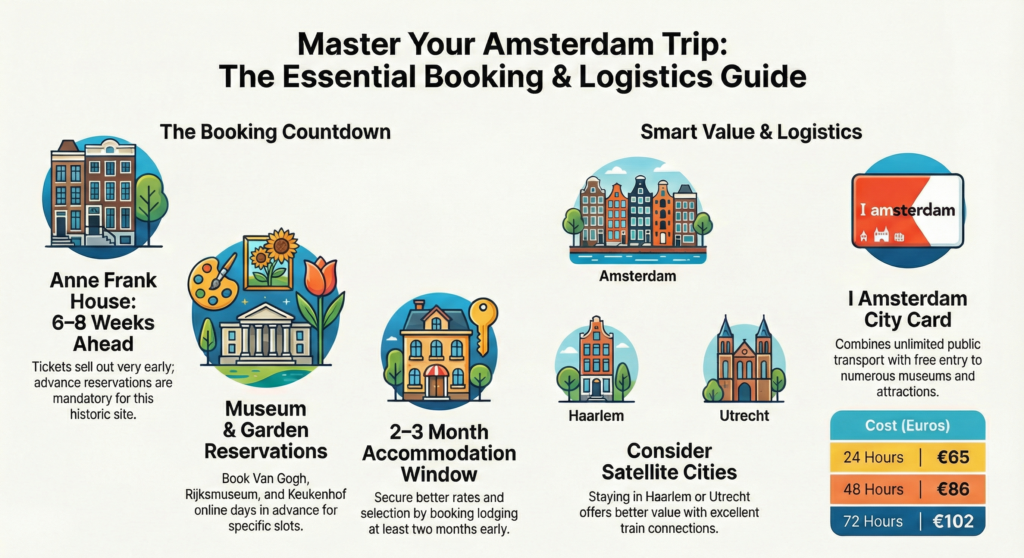
- Advance Reservations: Several attractions require or strongly benefit from advance booking. The Anne Frank House typically sells out 6-8 weeks ahead. Van Gogh Museum and Rijksmuseum tickets should be purchased online days in advance, especially during peak season. Keukenhof tickets (spring only) must be purchased online with specific dates and time slots. Popular dates sell out entirely. Train tickets for specific international routes or special services benefit from advance purchase, though domestic trains require no reservations.
- Amsterdam Museum Cards: The I Amsterdam City Card offers unlimited public transport within Amsterdam, plus free entry to numerous museums and attractions. Cards cost €65 for 24 hours, €86 for 48 hours, and €102 for 72 hours. The card provides value for visitors planning multiple museum visits and extensive public transport use.
- Accommodation Strategies: Booking accommodation 2-3 months ahead secures better rates and selection, particularly during the spring tulip season and summer months. Amsterdam offers the widest accommodation variety but commands premium prices. Consider staying in Haarlem, Utrecht, or neighborhoods outside Amsterdam’s center for better value with excellent train connections.
Food and Dining Recommendations

- Traditional Dutch Foods to Try: Stroopwafels, thin waffle cookies filled with caramel syrup, are ubiquitous throughout the Netherlands. Fresh stroopwafels from markets taste significantly better than packaged versions. Herring, eaten raw with onions and pickles, represents authentic Dutch street food tradition. Herring stands operate near harbors and markets. The Dutch consume herring by holding the fish by its tail and taking bites. Dutch pancakes (pannekoeken) differ substantially from American versions, being larger, thinner, and served with both sweet and savory toppings. Poffertjes, tiny fluffy pancakes served with butter and powdered sugar, appear at markets and fairs. Bitterballen, deep-fried balls with savory meat ragout filling, rank among popular bar snacks served with mustard. Kroketten, cylinder-shaped deep-fried snacks, come in numerous varieties.
- Where to Eat: Amsterdam’s diverse dining scene spans from Indonesian rijsttafel to Surinamese roti. The De Pijp neighborhood features particularly strong international food options. For traditional Dutch cuisine, brown cafes (bruine kroegen) serve hearty classics in atmospheric historic settings. Rotterdam’s Fenix Food Factory and Markthal showcase local producers and international cuisines under impressive architectural roofs. Utrecht’s Oudegracht canal-level restaurants offer a unique dining ambiance.
Netherlands Travel Etiquette
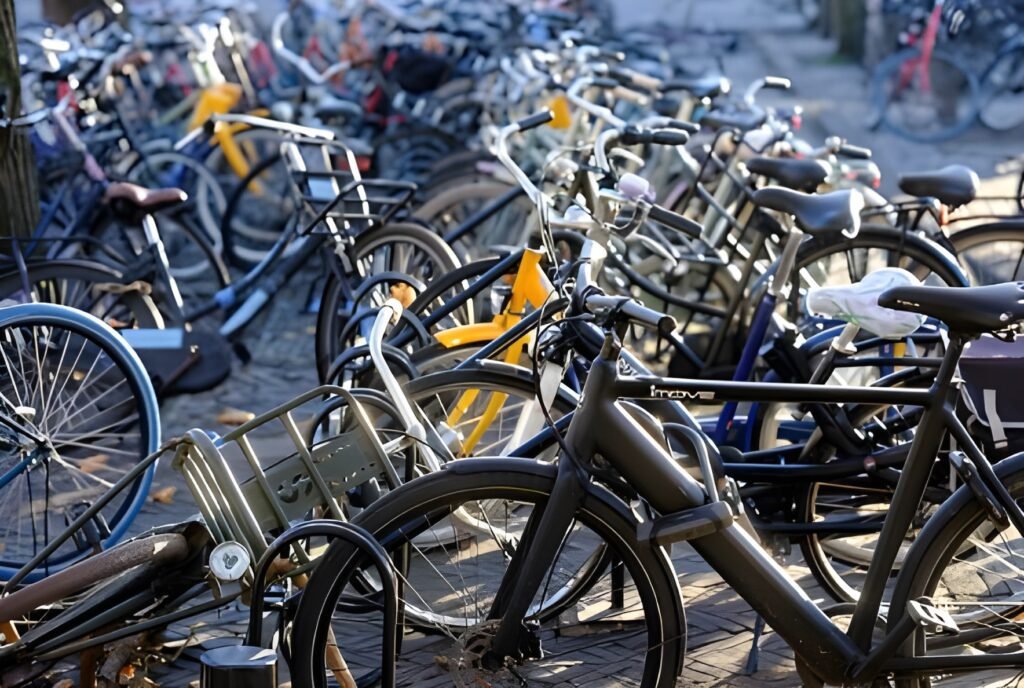
- Bicycle Culture Rules: Never walk in bike lanes marked by red pavement and bicycle symbols. Cyclists rarely stop for pedestrians in bike lanes. Look both directions before crossing bike paths, as cyclists approach rapidly and silently from both directions. Parked bicycles are private property. Do not sit on, lean against, or move others’ bicycles. Bike theft occurs frequently—always use locks when renting bicycles.
- Public Behavior: The Dutch value directness and efficiency in communication. Queue jumping is poorly regarded. Public drunkenness, while tolerated in designated nightlife areas, attracts disapproval in residential neighborhoods. Photography restrictions apply in certain contexts. Never photograph individuals in the Red Light District. Some museums prohibit flash photography or restrict photography entirely.
- Coffee Shop Culture: “Coffee shops” in the Netherlands serve cannabis products, where “cafes” serve coffee and food. This distinction confuses first-time visitors. The legal sale and consumption of cannabis in licensed coffee shops follows strict regulations. These establishments are not appropriate for children and primarily cater to adults seeking cannabis products.
Emergency Information
- Emergency Services: Dial 112 for police, fire, or ambulance emergencies throughout the Netherlands. This number works from any phone, including mobiles without SIM cards. Operators typically speak multiple languages, including English.
- Healthcare Access: The Netherlands provides excellent healthcare standards. Pharmacies (apotheek) operate throughout cities, with rotating night and weekend coverage. EU citizens should carry European Health Insurance Cards. Non-EU travelers should verify health insurance coverage before travel.
- Lost Items: Report lost passports immediately to your embassy. Major train stations operate lost-and-found offices for items left on trains or in stations. Many Dutch cities operate municipal lost-and-found services.
Frequently Asked Questions
Is 3 days enough to see the Netherlands?
Three days provide sufficient time to experience major highlights, including Amsterdam, one or two additional cities, and a day trip to either Keukenhof (spring), traditional villages, or Rotterdam/The Hague. While this timeframe cannot cover every attraction, strategic planning allows first-time visitors to experience diverse aspects of Dutch culture, architecture, and landscapes. Many travelers find that 3 days leaves them wanting to return for deeper exploration.
Should I base myself in one city or move between cities?
Staying in Amsterdam for all three nights simplifies logistics since the Netherlands’ compact size and excellent train connections make day trips feasible. However, travelers preferring to unpack once and explore different neighborhoods might split time between Amsterdam and Utrecht or The Hague. Moving accommodations daily is generally unnecessary and wastes valuable time. Most travelers find Amsterdam to be the most practical for 3-day trips.
Do I need to speak Dutch to visit the Netherlands?
No Dutch language skills are necessary for tourism. English proficiency throughout the Netherlands is exceptional, ranking among the world’s highest. Nearly all tourism staff, restaurant servers, hotel employees, and younger Dutch citizens speak excellent English. Signs in major cities include English translations, and museum audio guides offer English options. Learning basic Dutch phrases like “dank je” (thank you) and “alstublieft” (please) is appreciated but not essential.
What is the best month to visit the Netherlands?
April and May offer optimal conditions with tulip blooms, mild weather, and manageable crowds, though accommodation prices peak during this period. September provides an excellent alternative with pleasant temperatures, autumn colors, and fewer tourists. June through August brings the warmest weather, butthe heaviest crowds and highest prices. Winter months offer budget advantages with festive Christmas markets, though the weather can be cold and rainy. The ideal month depends on priorities regarding weather, crowds, prices, and specific attractions like Keukenhof.
How much does train travel cost in the Netherlands?
Train fares depend on distance traveled, with prices increasing approximately 6.5 percent annually. Example routes include Amsterdam to Rotterdam (approximately €15-20 one-way), Amsterdam to Utrecht (€8-12 one-way), and Rotterdam to The Hague (€4-8 one-way). Day tickets offering unlimited travel cost approximately €66 for second class. The OV-chipkaart smart card eliminates the €1 disposable ticket surcharge. International routes like Amsterdam to Brussels cost significantly more. Always check current pricing at NS.nl before travel.
Can I visit Keukenhof year-round?
No, Keukenhof Gardens operates only during the spring tulip season from March 20 to May 11 in 2025. The gardens close completely outside this eight-week window. Peak bloom typically occurs mid-April through early May. Travelers visiting outside the spring tulip season cannot access Keukenhof but can explore year-round attractions like museums, cities, and other countryside destinations. National Tulip Day in mid-January offers a preview event in Amsterdam’s Dam Square.
Is Amsterdam expensive for tourists?
Amsterdam ranks among Western Europe’s more expensive cities, though costs vary significantly based on choices. Accommodation commands premium prices, particularly in central locations during high season. However, budget options exist, including hostels, budget hotels in outer neighborhoods, and serviced apartments. Museums charge standard European rates. Public transportation is efficient and reasonably priced. Food costs range dramatically from affordable street food and supermarkets to expensive restaurants. Strategic planning enables budget-conscious travel while enjoying Amsterdam’s attractions.
Do I need advance tickets for Dutch museums?
Major Amsterdam museums, including the Anne Frank House, Van Gogh Museum, and Rijksmuseum, strongly recommend or require advance online booking. The Anne Frank House typically sells out weeks ahead and operates timed entry. Other museums allow same-day entry, but advance tickets eliminatethe queue waiting. During peak season (April-August), advance booking becomes more critical. Smaller museums and attractions in other cities generally allow walk-up entry, though checking websites before visiting prevents disappointment.
Summary: A thoughtfully planned Netherlands itinerary of 3 days allows first-time travelers to experience remarkable diversity within one compact country. From Amsterdam’s historic canals and world-class museums to Rotterdam’s cutting-edge architecture and Utrecht’s medieval charm, the Netherlands offers varied attractions accessible through excellent public transportation.
The country’s efficient rail network connects major cities within 30-60 minutes, maximizing sightseeing time while minimizing travel hassles. Whether exploring spring tulip fields at Keukenhof, cycling through traditional villages, or discovering architectural contrasts between cities, three days provide a substantial introduction to Dutch culture and landscapes.
Strategic advance planning, particularly for major museum tickets and spring season visits, ensures smooth experiences. The Netherlands’s exceptional English proficiency, bicycle infrastructure, and tourism facilities welcome first-time visitors with user-friendly logistics.
While three days cannot encompass every attraction, this timeframe allows travelers to experience essential highlights while gaining appreciation for Dutch efficiency, design, and cultural heritage. Most visitors leave planning return trips to explore regions and attractions missed during initial visits.
Disclaimer: This guide is based on publicly available tourism data, official travel resources, and general cost estimates. Prices and rules may vary depending on season and traveler profile. Train schedules, museum hours, and attraction availability change periodically. Keukenhof opening dates and Flower Parade schedules are subject to confirmation for future years. Always verify current information through official sources, including NS.nl for transportation, attraction websites for tickets and hours, and the Netherlands Board of Tourism (NBTC) for updated travel guidance before finalizing travel plans.