

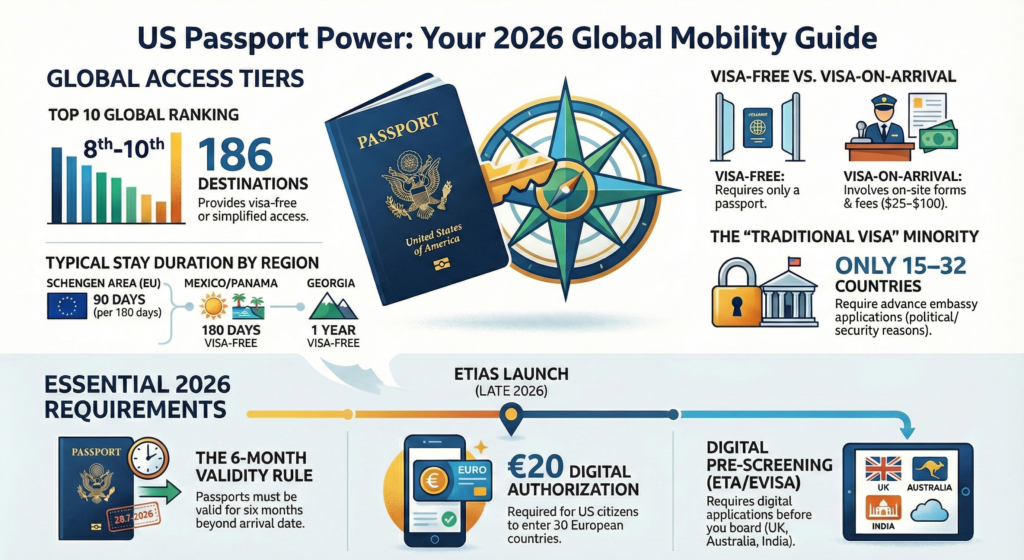
US passport holders enjoy exceptional global mobility with visa-free countries and access to approximately 180-186 destinations worldwide, according to 2026 passport strength rankings. The United States passport ranks between 8th and 10th globally, depending on the index consulted, providing American citizens with visa-free entry, visa-on-arrival, or electronic travel authorization (eTA/eVisa) options for the majority of countries and territories globally.
This comprehensive guide examines visa-free travel privileges for American citizens in 2026, including important changes like the upcoming European Travel Information and Authorization System (ETIAS), visa-on-arrival destinations, eVisa countries, and nations requiring traditional visa applications. Understanding these entry requirements helps US travelers plan international trips efficiently while avoiding unnecessary documentation complications or denied entry situations.
- Understanding the US Passport Strength in 2026
- What Determines Visa-Free Access
- Major Visa-Free Regions for US Citizens
- United Kingdom Electronic Travel Authorization
- Africa - Mixed Requirements
- Visa-on-Arrival Countries
- Electronic Visa (eVisa) Countries
- Countries Requiring Traditional Visas
- Important Passport Validity Requirements
- Blank Passport Pages
- Travel Restrictions and Denied Entry
- US State Department Travel Advisories
- Visa-Free vs Visa-On-Arrival: Key Differences
- Practical Travel Tips for US Passport Holders
- Regional Variations in Stay Duration
- Frequently Asked Questions
Understanding the US Passport Strength in 2026
According to multiple passport ranking systems, the US passport maintains a strong global standing despite minor variations in exact rankings. The Henley Passport Index ranks the US passport 10th globally, while other indices, including the Global Passport Index, place it between 8th and 14th position depending on methodology.
The US passport provides visa-free or visa-on-arrival access to 186 countries and territories, according to recent rankings. The Henley Passport Index specifically reports that US passport holders may travel to 180 countries and territories without a travel visa or with a visa on arrival.
These rankings consider multiple factors beyond simple visa-free access, including investment opportunities, quality of life indices, and enhanced mobility measures. The variations in exact numbers stem from different methodologies regarding how each index counts territories, partially recognized states, and distinguishes between visa-free entry versus visa-on-arrival privileges.
read: 25 + Top Cheap Weekend Getaways in the U.S. for 2026
What Determines Visa-Free Access
Visa-free access results from bilateral agreements between nations based on diplomatic relations, reciprocity principles, economic ties, security assessments, and tourism promotion objectives. Countries grant visa exemptions when they determine that citizens from specific nations present low immigration risk, a strong likelihood of departure compliance, and mutual benefit through tourism or business exchange.
The United States maintains extensive diplomatic networks with the second-highest number of diplomatic missions globally, facilitating visa negotiation and reciprocal access agreements. However, some nations restrict US access due to political tensions, security concerns, or reciprocity issues where the US imposes strict visa requirements on their citizens.
Read: 10 Best Weekend Breaks on a Budget in Norway
Major Visa-Free Regions for US Citizens
Europe – Schengen Area Access

US citizens do not need a tourist visa to enter any of the 27 countries of the European Union or the United Kingdom. The Schengen Area, comprising 27 European countries, allows Americans to travel freely without visas for tourism or business stays up to 90 days within any 180-day period.
Read: Best Weekend Getaways from Singapore for Travel Lovers
Important 2026 Update: ETIAS Requirement

Starting in late 2026, likely the last quarter, US citizens will need to obtain ETIAS (European Travel Information and Authorization System) approval before entering Schengen Area countries. ETIAS continues to be delayed for Americans traveling to the European Union, but is expected to begin in 2026.
ETIAS represents a pre-travel authorization system, not a visa. The application process involves:
- Online application through the official ETIAS portal
- €20 application fee (approximately $22 USD)
- Valid passport information
- Travel plans and basic personal information
- Security and health-related questions
Most ETIAS applications are processed within minutes, though in some cases it could take up to 96 hours. Travelers aged under 18 or over 70 do not pay the application fee, though authorization remains required.
Once approved, ETIAS authorization remains valid for three years or until passport expiration, whichever occurs first. The authorization allows multiple entries to Schengen countries for stays up to 90 days within any 180-day period.
ETIAS Applies to These 30 Countries: Austria, Belgium, Bulgaria, Croatia, Cyprus, Czech Republic, Denmark, Estonia, Finland, France, Germany, Greece, Hungary, Iceland, Italy, Latvia, Liechtenstein, Lithuania, Luxembourg, Malta, Netherlands, Norway, Poland, Portugal, Romania, Slovakia, Slovenia, Spain, Sweden, and Switzerland
Important Note: There will be a six-month transitional period during which travelers are encouraged to apply for ETIAS authorization, and during this time, if you meet all other entry conditions, you won’t be refused entry solely for not having an ETIAS.
Read: Amazing Budget-Friendly Weekend Getaways in Denmark
United Kingdom Electronic Travel Authorization

US citizens visiting the United Kingdom for short trips, tourism, or business need an Electronic Travel Authorization (ETA). This requirement began implementation in 2024-2025 and differs from ETIAS, which applies to Schengen countries. The UK is not part of the Schengen Area and maintains separate entry requirements.
Americas – Extensive Visa-Free Access
The Americas region provides extensive visa-free access for US passport holders. Most Central American, South American, and Caribbean nations allow Americans to enter without advance visas for tourism purposes.
Read: Best amazing places at newzaland that you can visit
Notable Visa-Free Destinations:

- Canada: Visa-free entry for tourism and business
- Mexico: Visa-free for tourism up to 180 days
- Costa Rica: Visa-free for up to 90 days
- Panama: Visa-free for up to 180 days
- Dominican Republic: Visa-free for up to 30 days
- Jamaica: Visa-free for up to 90 days
- Bahamas: Visa-free for up to 90 days
- Argentina: Visa-free for up to 90 days
- Chile: Visa-free for up to 90 days
- Colombia: Visa-free for up to 90 days
- Peru: Visa-free for up to 183 days
- Ecuador: Visa-free for up to 90 days
Some countries in the Americas require tourist cards or entry fees payable upon arrival, though these do not constitute traditional visas.
Read: Top 12 Dreamy Destinations Close to Germany for Your Vacation.
Asia-Pacific Region
Asia presents more varied visa requirements, with some nations offering generous visa-free access while others require advance visa applications.
Major Visa-Free Asian Destinations:

- Japan: Visa-free for up to 90 days for tourism or business
- South Korea: Visa-free for up to 90 days
- Singapore: Visa-free for up to 90 days
- Malaysia: Visa-free for up to 90 days
- Philippines: Visa-free for up to 30 days
- Thailand: Visa-free for up to 60 days (extended from 30 days in 2024)
- Taiwan: Visa-free for up to 90 days
- Hong Kong: Visa-free for up to 90 days
- Macao: Visa-free for up to 30 days
- Mongolia: Visa-free for up to 90 days
- Georgia: Visa-free for up to one year
- Israel: Visa-free for up to 90 days
- United Arab Emirates: Visa-free for up to 90 days
- Qatar: Visa-free for up to 30 days
Countries Requiring Visas or eVisas:
- China: Requires a visa for US citizens
- India: Requires eVisa or traditional visa
- Vietnam: Requires eVisa or traditional visa
- Cambodia: Visa-on-arrival or eVisa available
- Indonesia: Visa-free for up to 30 days (changed from visa-on-arrival in 2024)
- Australia: Requires Electronic Travel Authority (ETA)
- New Zealand: Requires Electronic Travel Authority (NZeTA)
Africa – Mixed Requirements
African nations present the most varied visa requirements for US passport holders, with some countries offering visa-free access, many providing visa-on-arrival options, and others requiring advance visa applications.
Read: Best Budget-Friendly Destinations in Sweden
Visa-Free Countries:

- Morocco: Visa-free for up to 90 days
- Tunisia: Visa-free for up to 90 days
- Botswana: Visa-free for up to 90 days
- South Africa: Visa-free for up to 90 days
- Mauritius: Visa-free for up to 90 days
- Seychelles: Visa-free for up to 90 days
- Cape Verde: Visa-free for up to 30 days
Visa-on-Arrival Options:
- Egypt: Visa-on-arrival available
- Kenya: eVisa required (no longer visa-on-arrival)
- Tanzania: Visa-on-arrival available
- Uganda: Visa-on-arrival available
- Zimbabwe: Visa-on-arrival available
- Madagascar: Visa-on-arrival available
Visa-on-Arrival Countries

Approximately 40-50 countries offer visa-on-arrival facilities for US passport holders. This means travelers receive visas upon landing at the airport or border crossing rather than applying in advance at embassies or consulates.
Visa-on-arrival typically requires:
- Valid passport (often with 6 months’ validity beyond arrival date)
- Return or onward flight tickets
- Proof of sufficient funds
- Payment of visa fee in cash (local currency or USD)
- Passport photos (occasionally)
- Completed the arrival card
Processing usually takes 15-60 minutes, depending on arrival volumes. Popular visa-on-arrival destinations include the Maldives, Jordan, Bahrain, Oman, Nepal, and numerous African nations.
Read: Planning a Europe Trip? Try These Unforgettable Day Trips From Luxembourg
Electronic Visa (eVisa) Countries

The eVisa system allows travelers to apply for visas online before departure, receiving electronic approval linked to their passport. This eliminates embassy visits while still requiring advance planning.
Common eVisa Destinations for US Citizens:
- India: eVisa for tourism, business, and medical purposes
- Turkey: eVisa required (replaced visa-on-arrival)
- Sri Lanka: Electronic Travel Authorization (ETA)
- Kenya: eVisa required
- Ethiopia: eVisa available
- Rwanda: eVisa available
- Zambia: eVisa available
- Australia: Electronic Travel Authority (ETA)
- New Zealand: Electronic Travel Authority (NZeTA)
- Canada: Electronic Travel Authorization (eTA) for air travel
eVisa processing times range from 24 hours to several weeks, depending onthe destination. Most eVisas cost between $25-100 with validity periods varying by country. Some nations offer expedited processing for additional fees.
Read: 10 + Best UK Places to Visit for Your Next Adventure
Countries Requiring Traditional Visas
Approximately 15-32 countries require US passport holders to obtain traditional visas through embassy or consulate applications before travel. These nations typically have political tensions with the United States, security concerns, or reciprocity issues.
Major Countries Requiring Traditional Visas:
- China: Tourist visa (L visa) required
- Russia: Tourist visa required (though US State Department advises against travel)
- Cuba: Tourist card required (available through airlines)
- Saudi Arabia: eVisa or traditional visa, depending on purpose
- Afghanistan: Visa required (travel strongly discouraged)
- Iran: Visa required (travel restricted)
- Iraq: Visa required
- Syria: Visa extremely difficult to obtain (travel banned for US citizens without special permission)
- Yemen: Visa required (travel strongly discouraged)
- Libya: Visa required (travel strongly discouraged)
- Sudan: Visa required
- Chad: Visa required
- Nigeria: Visa required
- Congo (DRC): eVisa required
- Belarus: Visa required (exceptions for Minsk airport transit)
US citizens are not permitted to travel to North Korea with or without a visa. To travel to North Korea, US passport holders need to obtain a special passport validation from the United States government.
Read: 10 Most Breathtaking Places to Explore in Canada
Important Passport Validity Requirements
Many countries impose minimum passport validity requirements beyond simple visa-free access. Countries requiring passports to be valid for at least 6 more months on arrival include Afghanistan, Algeria, Bahrain, Botswana, Cambodia, China, Costa Rica, Egypt, India, Indonesia, Israel, Jordan, Kenya, Malaysia, Nepal, Philippines, Saudi Arabia, Singapore, South Africa, Thailand, Turkey, United Arab Emirates, and Vietnam.
Some nations accept 3-month validity while others require 6 months. A few destinations mandate passport validity extending 6 months beyond the intended departure date rather than arrival date. Travelers should always verify specific requirements for their destination before booking international flights.
Read: The 10 best Popular tourist places in Australia
Blank Passport Pages

Most countries require 1-2 blank visa pages in passports for entry stamps, even when visas are not required. Endorsement pages do not count as valid blank pages. US citizens planning extensive international travel should renew passports when blank pages run low rather than waiting for expiration dates.
Read: Amazing Places to Visit in Guatemala in 2026
Travel Restrictions and Denied Entry
Beyond visa requirements, several factors can result in denied entry even to visa-free destinations:
Criminal Records: Countries including Australia, Canada, Fiji, New Zealand, and the United States routinely deny entry to non-citizens who have a criminal record. Restrictions depend on conviction type and sentence length. Serious crimes typically result in automatic denial, while minor offenses may require waivers or special permissions.
Israeli Passport Stamps: Kuwait, Lebanon, Libya, and Yemen do not allow entry to people with passport stamps from Israel or whose passports have either a used or unused Israeli visa. Israel now typically stamps separate entry cards rather than passports to avoid this issue, though evidence of Israel transit through neighboring country stamps may still cause problems.
Previous Destinations: Some countries screen visitors based on recent travel history. Visiting certain nations may complicate subsequent entry to countries with political tensions or security concerns related to those destinations.
Read: 10 Must-See Destinations in Puerto Rico That Belong on Your Bucket List
US State Department Travel Advisories
The US Department of State issues travel advisories warning Americans about safety concerns in various countries. These advisories do not prevent travel but inform citizens about risks. Four levels exist:
- Level 1: Exercise Normal Precautions
- Level 2: Exercise Increased Caution
- Level 3: Reconsider Travel
- Level 4: Do Not Travel
Level 4 advisories apply to countries experiencing active conflict, terrorism, civil unrest, or where Americans face kidnapping risks. While Americans can legally visit most Level 4 countries (except those with specific travel bans), doing so poses serious safety risks and may void travel insurance coverage.
Read: 15 Spellbinding Places in France That Deserve a Spot on Your Bucket List
Visa-Free vs Visa-On-Arrival: Key Differences
Visa-Free Entry:
- No visa application required
- Simply present a valid passport at the border
- Immigration stamp granted for a specific duration
- Immediate processing at passport control
- No fees required (except occasional tourist taxes)
Visa-On-Arrival:
- Visa issued at the airport/border upon arrival
- Requires documentation (photos, forms, and proof of funds)
- Involves fee payment (typically $25-100)
- Processing time 15-60 minutes
- May require specific passport validity (often 6 months)
Both systems allow spontaneous travel without advance embassy visits, though visa-on-arrival requires additional time, documentation, and expenses compared to true visa-free access.
Read: Amazing Places to Visit in Thailand – My Favorites
Practical Travel Tips for US Passport Holders
Always Carry Proof of Onward Travel
Many visa-free and visa-on-arrival destinations require proof of departure. Airlines may deny boarding without return or onward tickets even when countries don’t strictly enforce this requirement at borders. Refundable tickets, onward bus/train tickets, or throwaway tickets address this requirement.
Verify Current Requirements Before Travel
Visa policies change frequently. Countries modify requirements, introduce new systems like ETIAS, or adjust allowed stay durations. Always verify current entry requirements through official embassy websites or the US State Department’s country information pages immediately before booking travel.
Read: Best 10 Places to Visit in Djibouti | Unmissable 2026 Guide
Register with STEP
The Smart Traveler Enrollment Program (STEP) allows US citizens to register trips with the nearest US embassy or consulate. This enables the State Department to contact travelers during emergencies, natural disasters, or civil unrest, and helps family members reach travelers in crisis situations.
Purchase Travel Insurance
Travel insurance covering medical emergencies, trip cancellation, and evacuation provides essential protection. Many countries lack agreements for US health insurance coverage, meaning travelers face full-price medical costs. Comprehensive travel insurance prevents potential financial catastrophes from medical emergencies abroad.
Maintain Digital and Physical Copies
Keep digital copies of passport biographical pages, visa approvals, travel insurance, and important documents stored in cloud services or emailed to yourself. Physical photocopies separate from originals help replace lost documents and expedite emergency passport services.
Read: Best Places to Visit in Spain 2026 | Gorgeous Destinations
Regional Variations in Stay Duration
Visa-free access duration varies significantly by destination:
- 30 Days or Less: Philippines (30 days), Dominican Republic (30 days), Macao (30 days), Qatar (30 days)
- 90 Days (Most Common): European Union/Schengen Area (90 days within 180-day period), Japan (90 days), South Korea (90 days), most South American countries (90 days)
- 180 Days: Mexico (180 days), Panama (180 days), Peru (183 days)
- One Year: Georgia allows US passport holders visa-free stays up to one year, representing the longest standard visa-free period available globally.
Duration limits typically apply to tourism and business activities. Working, studying, or extended stays require appropriate visas regardless of visa-free access for tourism.
Read: Best Place to Travel in Colombia in This Year ?
Frequently Asked Questions
- How many countries can US passport holders visit without a visa?
As of January 2026, holders of US passports enjoy visa-free access to 145 countries and territories, with access to an additional 40-50 countries through visa-on-arrival or electronic visa systems. Total visa-free or simplified entry access reaches approximately 180-186 destinations, depending on how territories and visa-on-arrival options are counted. This represents a strong global mobility ranking the US passport ranked between 8th and 10th strongest worldwide.
- Will US citizens need ETIAS to travel to Europe in 2026?
Yes, starting in late 2026 (likely the last quarter), US citizens will need ETIAS authorization to enter Schengen Area countries. ETIAS is not a visa but rather a pre-travel electronic authorization costing €20 and valid for three years. The system involves a simple online application, taking minutes to complete, with most approvals granted immediately. A six-month transitional period will allow travel without ETIAS before the requirement becomes mandatory.
Read: Belgium’s Most Beautiful Places You Must Visit
- Do US citizens need a visa for Canada or Mexico?
No, US citizens do not need visas for tourism or business visits to Canada or Mexico. Canada allows visa-free entry, though it requires an Electronic Travel Authorization (eTA) for air travel. Mexico permits visa-free entry for up to 180 days for tourism. Both countries may require proof of citizenship (passport or enhanced driver’s license for land/sea crossings to Canada) and onward travel documentation.
Read: Discover Beautiful Places to Visit in Switzerland
Can US passport holders travel to China without a visa?
No, US citizens require visas to visit mainland China for tourism, business, or other purposes. China implemented stricter visa requirements for Americans following reciprocal visa policies. However, some exceptions exist, including transit visa exemptions for stays under 24-144 hours in certain cities, depending on specific conditions, and Hainan province offers visa-free access for tour groups under specific circumstances.
Read: Most Popular 10+ Best places to visit in The Netherlands
- What countries require 6 months of passport validity for US citizens?
Numerous countries require passports valid for at least 6 months beyond arrival or departure dates. Major destinations with this requirement include China, India, Indonesia, Israel, Malaysia, Philippines, Singapore, South Africa, Thailand, Turkey, United Arab Emirates, and Vietnam, among many others. Some European countries require only 3 months’ validity beyond planned departure. Always verify specific requirements for each destination before booking travel.
Read: The 10 Best Places to Visit in Dominica for an Unforgettable Trip.
- Can US citizens with criminal records travel internationally?
International travel with criminal records depends on specific countries, conviction types, and sentence details. Many countries, including Canada, Australia, New Zealand, and the United Kingdom, may deny entry to those with criminal records, particularly for serious offenses. Minor convictions may not cause issues in countries that don’t routinely screen for criminal history. Travelers with criminal records should research specific destination requirements and consider legal consultation for complex situations.
Read: Top 10 Surprising Places in Somalia You Should Visit
- Do I need a visa to visit the United Kingdom as a US citizen?
No, US citizens do not need visas for tourism or business visits to the United Kingdom for stays up to 6 months. However, starting in 2024-2025, Americans need an Electronic Travel Authorization (ETA) to be applied for online before travel. The UK is not part of the Schengen Area and maintains separate entry requirements from continental European nations. The UK ETA differs from Europe’s ETIAS system.
Read: Top Places to Visit in Hong Kong in 2026 for an Unforgettable Trip.
- What is the difference between visa-free and visa-on-arrival?
Visa-free entry allows travelers to simply present passports at borders without any visa application, fees, or waiting. Visa-on-arrival requires applying for visas upon landing, submitting documentation, paying fees (typically $25-100), and waiting for processing (15-60 minutes). Both systems avoid advance embassy visits, though visa-on-arrival involves additional steps, costs, and time compared to true visa-free access. Some countries transitioned from visa-on-arrival to visa-free status, simplifying entry procedures.
Read: 10 Best Places to Visit in Hungary for Your First Trip
Summary: The US passport provides exceptional global mobility with visa-free or simplified access to approximately 180-186 countries and territories in 2026. American citizens enjoy visa-free entry to all 27 European Union nations (pending ETIAS implementation in late 2026), the United Kingdom, most of the Americas, and numerous destinations in Asia, Africa, and Oceania.
Important upcoming changes include ETIAS authorization requirements for Schengen Area travel beginning late 2026, representing a significant shift in European entry procedures. While not a traditional visa, ETIAS requires an advanced online application, a €20 fee, and approval before travel.
Regional access varies withthe strongest privileges in Europe and the Americas, moderate access in Asia-Pacific, and most variable requirements in Africa and the Middle East. Approximately 15-32 countries require traditional visa applications, primarily nations with political tensions, security concerns, or reciprocity issues with the United States.
Read: Top 11 Iconic and Beautiful Places to Visit in Italy
Understanding visa requirements, passport validity rules, visa-on-arrival procedures, eVisa systems, and travel advisories enables US passport holders to plan international trips efficiently while avoiding documentation complications or denied entry situations. Always verify current requirements through official sources before booking travel, as policies change frequently.
Disclaimer: This guide is based on publicly available tourism data, official travel resources, and general cost estimates. Visa requirements, entry policies, and travel regulations change frequently and without advance notice. The information provided represents general guidance current as of early 2026 but may not reflect the most recent policy changes for specific destinations. ETIAS implementation dates remain subject to confirmation by European Union authorities. Passport validity requirements, visa-on-arrival procedures, eVisa systems, and specific entry conditions vary by nationality, purpose of visit,
And individual circumstances. Always verify current visa requirements, entry policies, and travel advisories through official sources, including destination country embassy websites, the US Department of State’s Bureau of Consular Affairs, and official government travel information portals before finalizing travel plans. Criminal records, previous travel history, passport condition, and other factors may affect entry eligibility even to visa-free destinations. This article provides informational guidance only and does not constitute official travel, legal, or immigration advice.