

Determining the Maldives ‘ cheap season requires understanding monsoon patterns, seasonal pricing fluctuations, and tourism trends to access this luxury destination affordably. According to comprehensive 2026 tourism data and verified travel reports, the visit Maldives most budget-friendly period spans May through October during southwest monsoon season when accommodation costs drop 20-60% compared to peak dry season, with July and August representing the absolute cheapest months delivering resort discounts of 30-50% and local island guesthouses from $40-60 nightly versus $100-200+ during December-April peaks, though travelers accept brief afternoon rain showers and potentially reduced diving visibility in exchange for exceptional savings and exclusive resort experiences with minimal crowds.
This comprehensive guide examines month-by-month Maldives budget timing, analyzes monsoon season trade-offs versus dry season premiums, provides specific cost comparisons across peak and off-peak periods, and delivers practical money-saving strategies to help budget travelers experience overwater villas, pristine beaches, world-class diving, and turquoise lagoons affordably in 2026.
Understanding Maldives Seasonal Pricing Patterns
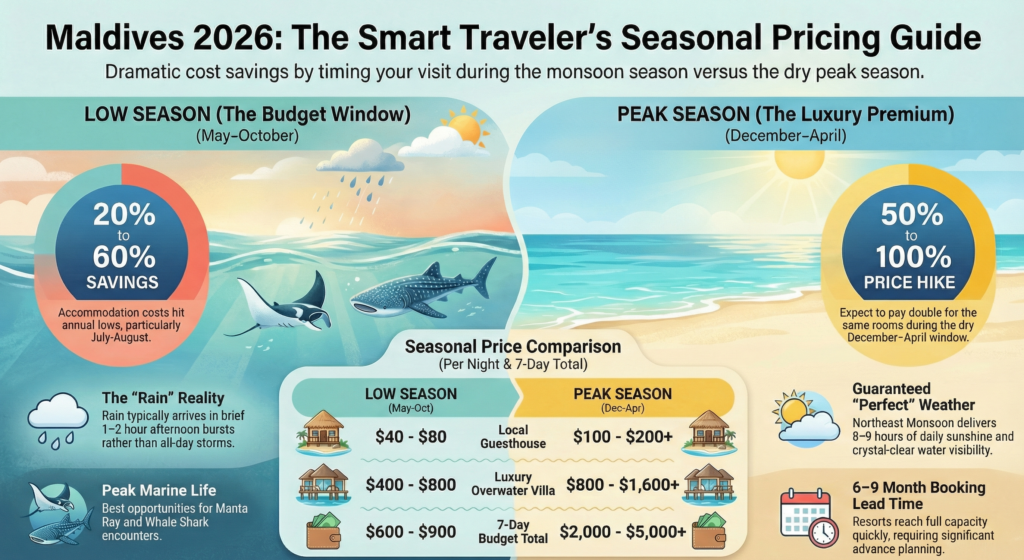
The Maldives experiences among the world’s most dramatic seasonal price fluctuations for a beach destination, according to 2026 booking data.
Peak Season (December-April): Dry northeast monsoon brings guaranteed sunshine, calm seas, and premium pricing with resorts charging 50-100% more than low season. Christmas and New Year command absolute peak rates.
Shoulder Season (Late April-May, September-November): Transitional periods deliver moderate weather with occasional rain, 25-40% discounts versus peak season, and a good balance between conditions and value.
Low Season (May-October): Southwest monsoon creates Maldives’ budget window with 20-60% accommodation discounts, particularly July-August when prices hit annual lows despite brief afternoon showers and warm swimming conditions.
Read: France Travel Budget for 7 Days: Complete Cost Guide 2026
Cheapest Months to Visit Maldives
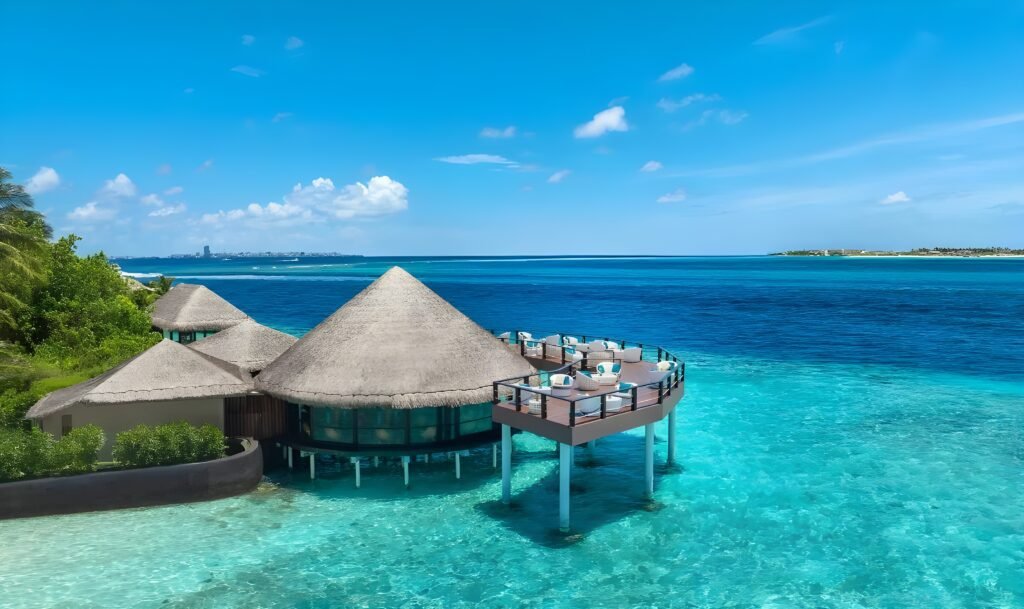
May: Early Monsoon Bargains
May marks the transition from dry to wet season, creating the first major price drops according to 2026 pricing data.
- Accommodation Savings: 30-40% below peak season rates as resorts prepare for monsoon period. Luxury properties that cost $800-1,200 nightly in February drop to $500-700 in May.
- Weather Conditions: First monsoon showers appear late April into May, though most days feature 7-8 hours sunshine. Sea temperature remains bath-warm at 30°C (86°F). Brief afternoon rain showers typical.
- Advantages: Manta ray season begins in western atolls. Hanifaru Bay UNESCO Biosphere Reserve hosts massive seasonal manta gatherings May through November, delivering world-class snorkeling experiences.
- Best For: Budget travelers accepting occasional rain for substantial savings while maintaining good overall weather.
June-July: Deepest Discounts
Mid-monsoon June and July offer Maldives’ absolute cheapest rates according to tourism analysis.
- Accommodation Savings: 40-60% below peak season. Local island guesthouses drop to $40-80 nightly versus $100-200+ peak rates. Luxury resorts offer 50% discounts with overwater villas from $400-600 versus $800-1,200+.
- Weather Reality: Short but heavy showers common, particularly June. However, rain typically arrives in brief 1-2 hour afternoon bursts before clearing to sunshine. Expect 6-7 hours daily sunshine between showers.
- Diving Considerations: Water visibility reduces compared to dry season though many dive sites remain excellent. Manta rays and whale sharks concentrate in plankton-rich waters creating extraordinary encounters.
- Crowd Levels: Resorts experience lowest occupancy creating exclusive atmosphere and attentive service despite budget pricing.
- Best For: Extreme budget travelers prioritizing maximum savings over guaranteed perfect weather. Surfers targeting southwest-facing breaks.
Read: Turkey Travel Cost from Europe: Flights, Hotels & Daily Budget
August: Value with European Crowds
August maintains monsoon season discounts while experiencing temporary demand increase from European summer holidays.
- Pricing: 30-50% below peak season though slightly higher than June-July due to European family travel demand. Still represents excellent value overall.
- Weather: Similar to June-July with brief afternoon showers interspersed with sunshine. Swimming remains ideal with warm 29-30°C (84-86°F) water temperatures.
- Atmosphere: Busier than June-July but dramatically quieter than December-April peaks. Families from Europe create moderate occupancy versus near-empty June conditions.
- Best For: Budget travelers with school-age children constrained by August timing. Value-seekers accepting slightly less dramatic discounts for marginally better availability.
September: Optimal Budget Shoulder Month
September represents many travelers’ ideal budget-season choice according to expert recommendations.
- Pricing: 25-40% below peak season with excellent value. Positioned between peak monsoon (June-July) and returning dry season (November onwards).
- Weather Balance: Transitional conditions with improving weather patterns. Showers decrease in frequency and duration compared to June-August. Average 7-8 hours daily sunshine.
- Marine Life: Manta rays and whale sharks still abundant. South Ari Atoll delivers 80% whale shark encounter success rates during morning dives.
- Crowd Levels: Very quiet before October shoulder season crowds begin arriving.
- Best For: Budget travelers seeking optimal weather-to-cost ratio. Those wanting substantial savings with improving conditions.
October: Late Monsoon Transition
October marks monsoon season’s end with variable weather and moderate pricing.
- Accommodation Costs: 20-35% below peak season as prices begin climbing toward November-December peaks.
- Weather Variability: October typically records highest annual rainfall with 6-8 inches distributed across month. However, rain usually arrives in short heavy bursts rather than all-day storms.
- Advantages: Rates hit annual lows for diving-focused trips. Eastern atolls benefit from clearer water as monsoon weakens.
- Booking Strategy: Sometimes offers last-minute deals 2-4 weeks before travel as resorts fill remaining low-season inventory before peak season begins.
- Best For: Flexible travelers monitoring last-minute availability. Diving enthusiasts prioritizing marine encounters over perfect weather.
Peak Season Months (Most Expensive)
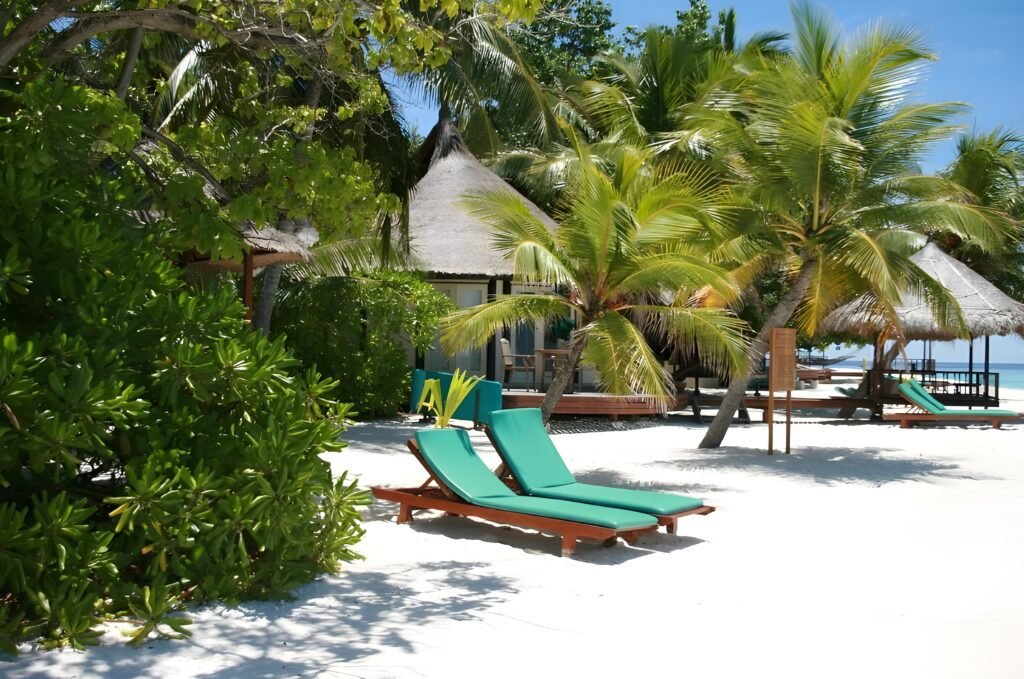
December-February: Premium Dry Season
Peak dry season commands Maldives’ highest annual pricing according to 2026 booking data.
- Cost Premium: 50-100% above monsoon season rates. Beach villas averaging $400 in July jump to $800-1,200 in January.
- Christmas/New Year: Absolute peak with rates increasing additional 50-100% above standard peak pricing. Some resorts require minimum 7-10 night stays with rates exceeding $2,000-3,000 nightly for premium overwater villas.
- Weather Perfection: Northeast monsoon delivers 8-9 hours daily sunshine, minimal rainfall, calm seas, and crystal-clear diving visibility. Virtually guaranteed perfect conditions.
- Crowd Reality: Resorts reach full capacity, requiring 6-9 months advance booking. Popular local islands experience significant tourist volume.
- Justification: Honeymooners, first-time visitors, and those prioritizing guaranteed weather over budget considerations find peak season worth premium costs.
Read: Greece Travel Cost for Couples (Full Budget Breakdown 2026)
March-April: Late Peak Season
Extended dry season maintains high pricing with slight moderation versus December-February.
- Pricing: 30-50% above monsoon season though 10-20% below Christmas/January peaks. Three-star local island guesthouses $100-180 versus $50-80 monsoon season.
- Weather Conditions: Excellent through mid-April with occasional late-April showers marking transition toward monsoon. Average 8 hours daily sunshine.
- Crowd Levels: Remain elevated though somewhat reduced compared to Christmas-February peaks. Easter week sees temporary spike in rates and occupancy.
- Best For: Peak-season-quality weather at somewhat moderated costs for travelers with March-April flexibility.
Budget-Friendly vs. Luxury Maldives Costs
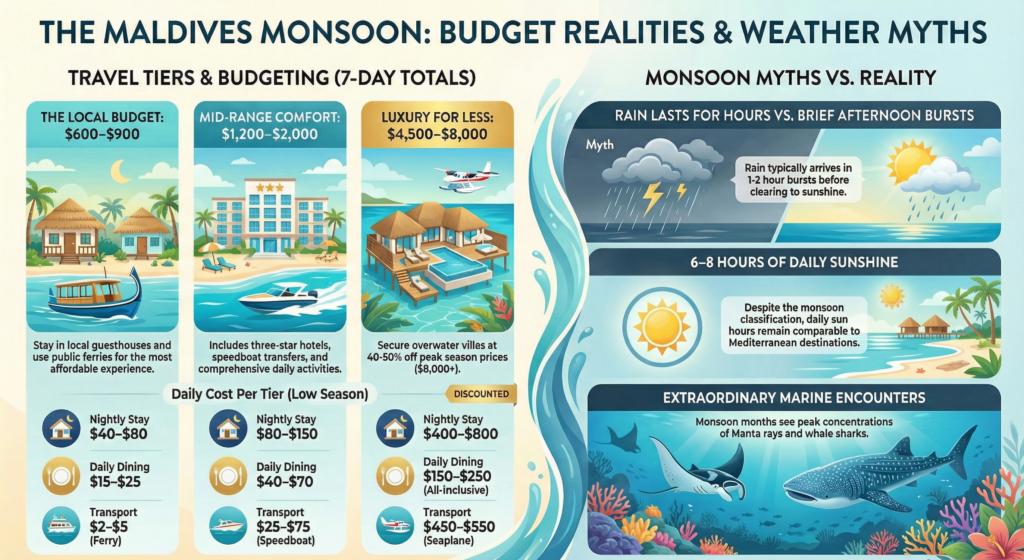
Low Season Budget Travel (May-October)
- Local Island Guesthouses: $40-80 per night Budget Local Dining: $15-25 daily Public Ferry Transportation: $2-5 between islands Snorkeling Equipment Rental: $5-10 daily Organized Tours: $30-60 per person
- 7-Day Budget Total: $600-900 per person (accommodations, food, activities, inter-island transport)
Read: Best Time to Visit Switzerland for Budget Travel (Full Cost Guide 2026)
Low Season Mid-Range Travel
- Three-Star Local Island Hotels: $80-150 per night Restaurant Dining: $40-70 daily Speedboat Transportation: $25-75 between islands Comprehensive Activities: $50-100 daily
- 7-Day Mid-Range Total: $1,200-2,000 per person
Low Season Luxury Resort (40-50% Discount)
- Overwater Villa with Pool: $400-800 per night (versus $800-1,600 peak) All-Inclusive Meal Plan: $150-250 daily Seaplane Transfer: $450-550 return per person Premium Activities: $100-300 daily
- 7-Day Luxury Total (discounted): $4,500-8,000 per person (versus $8,000-15,000 peak season)
Read: Spain Travel Cost Breakdown (2026): Flights, Hotels & Daily Budget
Weather Reality: Monsoon Season Misconceptions
According to verified traveler reports and meteorological data, Maldives monsoon season weather proves far less disruptive than many anticipate.
- Rain Pattern Reality: Southwest monsoon rain typically arrives in brief 1-2 hour afternoon bursts before clearing to sunshine. All-day continuous rain remains rare even during peak monsoon months.
- Sunshine Hours: June-August average 6-7 hours daily sunshine despite monsoon classification. April-May and September-October deliver 7-8 hours daily sun comparable to many peak-season Mediterranean destinations.
- Swimming Conditions: Ocean temperatures remain constant 29-30°C (84-86°F) year-round. Brief rain showers create romantic atmosphere for swimming according to traveler feedback.
- Diving Considerations: Visibility reduces from 30-40 meters dry season to 15-25 meters monsoon season though many dive sites remain excellent. Manta rays and whale sharks concentrate during monsoon creating extraordinary encounters offsetting visibility reduction.
- Resort Activities: Indoor resort amenities (spas, restaurants, bars, fitness centers) operate identically during monsoon. Brief afternoon showers rarely disrupt full-day itineraries.
Money-Saving Strategies
- Choose Local Islands Over Private Resorts: Local inhabited islands including Maafushi, Thulusdhoo, Dhigurah, and Gulhi offer guesthouses from $40-80 nightly versus $300-1,500+ resort rates. Public beaches, authentic culture, and local dining create 60-70% cost reductions.
- Travel May or September: These shoulder months balance decent weather (7-8 hours daily sunshine) with 30-40% savings versus peak season while avoiding June-July peak monsoon conditions.
- Book Last-Minute Low Season: Monitoring availability 2-4 weeks before travel during June-October sometimes yields 50-60% discounts as resorts fill remaining rooms. Risky but delivers maximum savings for flexible travelers.
- Use Public Ferries: Inter-island public ferries cost $2-5 versus $25-75 speedboat transfers. Schedules require planning and ferries don’t run Fridays, but savings substantial for multi-island itineraries.
- Split-Stay Strategy: Combine 2-3 nights luxury resort (discounted low season) with 4-5 nights local island guesthouse maximizing diverse experiences while controlling costs. Popular strategy among budget-conscious couples.
- Monitor Early-Bird Offers: Luxury resorts offer 25-35% discounts for bookings made 4-6 months ahead even during peak season. Combining advance booking with low-season travel creates maximum savings.
- Self-Cater Breakfast: Local islands permit purchasing groceries enabling breakfast preparation saving $10-20 daily versus resort mandatory meal plans.
Frequently Asked Questions
What is the cheapest month to visit the Maldives?
According to comprehensive 2026 pricing data, June and July represent the Maldives’ absolutely cheapest months with accommodation costs 40-60% below peak season. Luxury resort overwater villas drop from $800-1,200 nightly (December-February) to $400-600 in June-July, while local island guesthouses cost $40-80 versus $100-200+ peak rates. May and September offer excellent value alternatives with 30-40% savings and slightly better weather than mid-monsoon June-July. However, all travelers face brief afternoon rain showers during monsoon season (May-October).
Is it worth visiting Maldives during monsoon season?
Yes, monsoon season (May-October) delivers exceptional value for budget travelers according to verified traveler reports. Accommodation savings of 20-60%, dramatically reduced crowds, and exclusive resort atmospheres justify accepting brief afternoon rain showers that typically last 1-2 hours before clearing. Sunshine averages 6-8 hours daily even during peak monsoon months. Swimming remains ideal with 29-30°C (84-86°F) water temperatures. Manta ray and whale shark encounters peak during monsoon season offsetting marginally reduced diving visibility. Budget travelers save $2,000-5,000+ per week compared to peak season costs.
How bad is Maldives weather in July and August?
July and August monsoon weather proves far less disruptive than many travelers anticipate according to meteorological data and traveler feedback. Brief heavy afternoon showers typical (1-2 hours) followed by clearing skies and sunshine. All-day continuous rain remains rare. Visitors still enjoy 6-7 hours daily sunshine between showers. Ocean temperatures stay warm at 29-30°C (84-86°F) making swimming comfortable year-round. Resort indoor facilities (spas, restaurants, bars) operate normally. Many travelers report romantic atmosphere swimming during brief tropical showers.
When should I book Maldives for best prices?
For low season (May-October), book 2-3 months ahead for optimal selection while maintaining budget pricing. Last-minute bookings 2-4 weeks before travel sometimes yield 50-60% discounts though availability becomes limited. For peak season (December-April), book 6-9 months ahead as popular resorts sell out and prices increase closer to travel dates. Early-bird resort bookings 4-6 months advance often include 25-35% discounts even during peak periods. Monitor resort newsletters for exclusive subscriber promotions delivering additional savings.
Can I visit Maldives on a budget?
Yes, budget Maldives travel became possible after 2009 policy changes allowing guesthouses on local inhabited islands according to tourism industry reports. Local islands including Maafushi, Thulusdhoo, and Dhigurah offer guesthouses from $40-80 nightly, local restaurant meals $15-25 daily, and public ferry transport $2-5 between islands. Seven-day budget trips cost approximately $600-900 per person during low season covering accommodation, food, activities, and inter-island transport. Traveling May-October creates 40-60% savings versus December-April peaks.
What is shoulder season in Maldives?
Maldives shoulder seasons occur during late April-May and September-November transitional periods between dry (December-April) and monsoon (May-October) seasons according to tourism classification. These months deliver 25-40% accommodation discounts versus peak season while maintaining 7-8 hours daily sunshine and generally pleasant conditions with occasional rain showers. September represents the optimal shoulder month balancing good weather with substantial savings. Shoulder periods attract fewer crowds than peak season while avoiding June-July peak monsoon conditions.
Do luxury resorts offer monsoon season discounts?
Yes, luxury Maldives resorts offer substantial 30-60% monsoon season discounts (May-October) compared to December-April peak rates according to 2026 booking data. Overwater villas with private pools costing $1,000-2,000 nightly peak season drop to $400-800 during monsoon months. All-inclusive packages include 20-40% discounts plus value-added amenities like spa credits ($200-500) or complimentary seaplane transfers ($500 per person return). Resorts maintain identical service standards and facility access during low season creating exceptional luxury value for travelers accepting brief afternoon rain showers.
Is diving good in Maldives during monsoon?
Diving during Maldives monsoon season (May-October) delivers excellent marine encounters according to dive operators and traveler reports, though visibility reduces from 30-40 meters dry season to 15-25 meters. Manta ray season peaks May-November with Hanifaru Bay hosting 100-200 seasonal gatherings. Whale shark encounters increase during plankton blooms May-December with South Ari Atoll maintaining 80% success rates. Eastern atolls benefit from clearer water during southwest monsoon. Many divers prioritize marine life encounters over visibility, making monsoon season worthwhile combined with 40-60% cost savings.
Summary: The maldives cheap season spans May through October during southwest monsoon period when accommodation costs drop 20-60% compared to peak December-April dry season. June and July represent the absolute cheapest months delivering luxury resort discounts of 40-60% (overwater villas $400-600 versus $800-1,200 peak) and local island guesthouses from $40-80 nightly versus $100-200+ peak rates, though travelers accept brief 1-2 hour afternoon rain showers and marginally reduced diving visibility in exchange for exceptional savings, exclusive resort atmospheres, and minimal crowds.
May and September provide optimal budget shoulder months balancing 30-40% cost savings with 7-8 hours daily sunshine, improving weather conditions, and extraordinary manta ray and whale shark encounters during peak seasonal gatherings. Budget travelers save $2,000-5,000+ per week during monsoon season versus peak period costs while experiencing identical resort facilities, warm 29-30°C (84-86°F) swimming temperatures, and romantic tropical shower atmospheres between sunshine periods.
Strategic timing including May-September travel, local island guesthouse selection versus private resort islands, public ferry transportation ($2-5 versus $25-75 speedboats), split-stay combinations blending 2-3 nights discounted luxury resorts with 4-5 nights local islands, and last-minute monitoring for 50-60% June-October deals creates accessible Maldives experiences for budget travelers at $600-900 weekly versus $3,000-8,000+ peak season costs.
Peak season December-April delivers guaranteed sunshine (8-9 hours daily), calm seas, crystal-clear diving visibility, and premium conditions justifying 50-100% cost premiums for honeymooners, first-time visitors, and travelers prioritizing perfect weather over budget considerations, requiring 6-9 months advance booking due to capacity constraints and elevated demand.
Whether seeking absolute rock-bottom July prices accepting peak monsoon showers, balanced September shoulder season conditions with substantial savings, or guaranteed December-February perfection at premium rates, the Maldives accommodates diverse traveler priorities and budgets across its two distinct seasonal patterns delivering unforgettable overwater villa experiences, world-class diving, pristine beaches, and turquoise lagoon paradise.
Disclaimer: This guide is based on publicly available tourism data, official travel resources, and general cost estimates current as of 2026. Prices and rules may vary depending on season and traveler profile. Accommodation costs fluctuate dramatically between peak season (December-April, particularly Christmas/New Year) and low season (May-October) with variations of 40-100% common across identical properties. Weather patterns vary annually with monsoon season (May-October) typically featuring brief 1-2 hour afternoon showers though occasional longer rainy periods occur.
Diving visibility reduces during monsoon from 30-40 meters to 15-25 meters though specific conditions vary by atoll, depth, and daily weather. Manta ray season (May-November) and whale shark season (May-December) represent general patterns though specific sighting success rates vary by location and timing within seasons. The 2009 policy allowing local island tourism enabled budget travel options though alcohol remains prohibited on all local inhabited islands per Islamic law. Public ferry schedules require verification as routes and frequencies change seasonally and ferries do not operate Fridays. Resort pricing quoted represents general 2026 market ranges though specific properties vary substantially based on brand, location, amenities, and booking timing.
Early-bird discounts (25-35% when booking 4-6 months ahead) and last-minute deals (40-60% when booking 2-4 weeks ahead during low season) depend on availability and demand. Always verify current pricing, weather forecasts, ferry schedules, and resort policies through official sources, property websites, and recent traveler reports before finalizing travel plans. This article provides informational guidance only and does not constitute official travel or financial advice.